



Mathematics
Department of Mathematical Sciences
Faculty of Science
Established in 1956 under founding Chairman Prof. Dr. Suleman Kerawala, the Department of Mathematics is one of the largest departments in the Faculty of Science, with a well-equipped auditorium and E-Library.

Pure & Applied Mathematics
BS leading to MA, MSc, MPhil and PhD with a major in Mathematics.
Financial & Computational Mathematics
Coursework spans programming, actuarial science and data science.
Research Strength
Recognized internationally in Non-Linear Mechanics and Dynamical Systems.
The department is known abroad for its academic influence, especially in Non-Linear Mechanics, Dynamical Systems, Convex Analysis, Numerical Integration, Differential Equations, Mathematical Inequalities, and Mathematical and Statistical Modeling in Climate Dynamics and Scientific and Engineering Computing.
CareersCareer Opportunities
Graduates pursue careers in teaching and research (including at SUPARCO and in aviation), actuarial science, data science, business analysis, information technology and computing, and interdisciplinary fields such as astronomy, climate studies and robotics.

Introduction
Chairman: Prof. Dr. Najeeb Alam Khan.
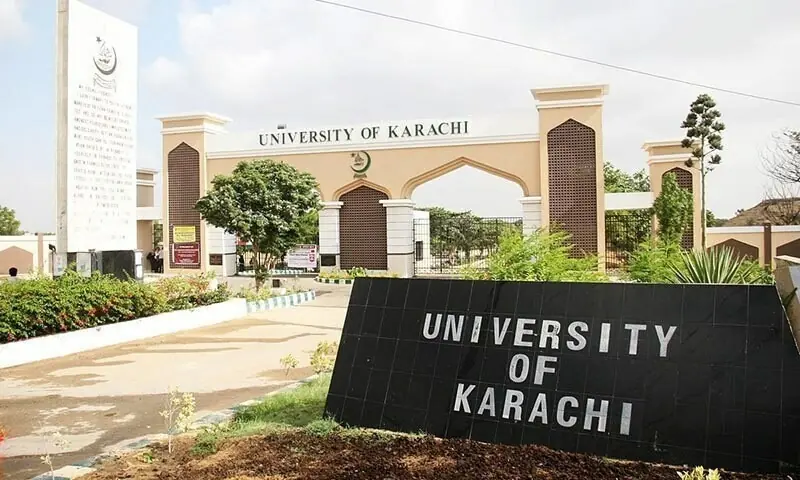
The University of Karachi holds a unique position in the country's educational system. Its prestigious research and teaching institution meets the commitment to spreading knowledge through its programs. The research activities comprise original investigations, discussions, lectures, and teaching at various levels. We are deeply committed to supreme research in mathematics, and the scientific excellence of our faculty is well recognized.
Department of Mathematics was established in 1956, and Prof. Dr. Suleman Kerawala was the founder Chairman. It is one of the largest departments of the Faculty of Science, having a well-equipped auditorium, E-laboratory with free internet and E-Library.
We offer academic challenges and support to our students to help them succeed. We encourage them to develop problem-solving abilities to excel in mathematics. We collaborate with local community organizations, professional associations, other campus entities, and individuals. We promote the belief that mathematics holds an essential place in the history of humanity and it is valuable in the future of all disciplines.
We offer BS in pure, applied, financial, and computational mathematics. The Bachelor programs lead to the Master of Arts, Master of Science, Master and Doctor of Philosophy degrees with a major in Mathematics. In these programs, we cover a variety of subjects related to Mathematics, such as: Programming, business management, actuarial sciences, data sciences, accounting, and engineering etc.
The department is well-known for its long history, strength, and rigorous scholarships. Since its establishment, many outstanding mathematicians have served here. It has always had a leading status at home. It has been well-known abroad for its academic influences, especially in Non-Linear Mechanics, Dynamical Systems, Convex Analysis, Numerical Integration, Differential equations, Mathematical Inequalities, Mathematical and Statistical Modeling in Climate Dynamics, and Scientific and Engineering Computing.
Career Opportunities
The most common career paths of graduating students fall into some broad categories. The Department has designed the concentrations (and course requirements for each concentration) to help students prepare for a career (not limited to) in one of these main categories:
Teaching/Research related Fields at SUPARCO and Aviation.
Actuarial science.
Data science.
Business Analyst.
Information technology and computing.
Business, management, consulting.
Teaching / Research projects related to interdisciplinary fields such as: astronomy, climate related studies, robotics and other computing fields etc.
Departmental Web
Faculty
Professor
Dr. Najeeb Alam Khan
Dr. Muhammad Jamil
Associate Professors
Dr. Muhammad Ayaz Profile
Area of working: Artificial Neural Networks, Algebra, Stochastic Modeling
Dr. Asif Raza Khan
Areas of working: Measure Theory, Mathematical Analysis
Dr. Saqib ur Rehman
Area of working: Mathematical and Statistical Modeling Climate Dynamics, Time Series Analysis
Dr. Asmat Ara
Dr. Aurangzaib
Assistant Professors
Mr. Waseem Ahmed Khan
Areas of working: Calculus, Differential Equation, Fluid Dynamics
Dr. Syeda Sadia Zia
Areas of working: Algebra, Numerical Analysis
Mr. Waseem Ahmad Ansari
Area of working: Linear Algebra
Dr. Saba Naz
Area of working: Data Analysis, Differential Geometry
Dr. Tanveer Ahmed Siddiqi
Area of working: Computational Mathematics, Data Analysis
Dr. Muhammad Imtiaz
Area of working: Operation Search, Fluid Dynamics
Dr. Syed Inayatullah
Area of working: Operation Search, Linear Programming
Dr. Syed Ahmad Hassan
Area of working: Mathematical Modeling Climate Dynamics, Time Series Analysis
Dr. Fozia Hanif
Area of working: Operation Research
Assistant Professors (T)
Dr. Hina Zaheer
Area of working: Data Structure, Operations Research
Dr. Asma Rani
Area of working: Optimization Theory, Linear Algebra, Calculus
Dr. Noor Fatima Siddiqui
Area of working: Numerical Analysis, Differential Equations, Fluid Dynamics
Lecturers
Mr. Shahid
Area of working: Analysis, Differential Equations, Algebra
Mr. Asif Iqbal
Area of working: Algebra, Discrete Mathematics
Ms. Hafsa Athar Jafree
Area of working: Algebra, Numerical Analysis
Dr. Ateeq Razzak (On Leave)
Area of working: Fluid Dynamics, Numerical Analysis
Mr. Salman Safdar (Study Leave)
Area of working: Dynamical Systems, Algebra
Ms. Samira Sahar Jamil
Area of working: Topology, Algebra, Analysis
Dr. Sumayyah Saadi
Area of working: Analysis, Inequalities
Mr. Muhammad Usman Qureshi
Area of working: Calculus, Algebra, Analysis
Ms. Wajiha Riaz
Area of working: Optimization Theory, Algebra, Calculus
Ms. Aghzia Akram
Area of working: Algebra, Analysis
Dr. Mehwish Shafi Khan
Area of working: Mathematical Modelling, Time Series Analysis
Programs
Program Details and Eligibility Criteria
| S.No. | Program | Eligibility Criteria |
| 1 | BS Mathematics | Intermediate (Science/Arts) with Mathematics at least 50% marks |
| 2 | BS Financial Mathematics | Intermediate (Science/Arts) with Mathematics at least 50% marks |
| 3 | BS Computational Mathematics | Intermediate (Science/Arts) with Mathematics at least 50% marks |
| 4 | BS Third Year/M.Sc. (Previous) | B.A/B.Sc. (With Mathematics)/B.E./B.C.S, Graduation with Diploma in Mathematics from UoK |
Courses
| Course Code | Course Title | Credit Hours (Theory) | Credit Hours (Practical) |
| B. Sc. (Hons) First Years | |||
| Semester - I | |||
| 300.1 (Comp.) | Pakistan Studies (Compulsory) | 3 | 0 |
| 301 (H) | Algebra | 3 | 0 |
| Semester - II | |||
| 300.2 (Comp.) | English (Compulsory) | 3 | 0 |
| 302 (H) | Calculus | 3 | 0 |
| Semester - III | |||
| 400.1 (Comp.) | Islamic Studies (Compulsory) | 3 | 0 |
| 401 (H) | Geometry | 3 | 0 |
| 403 (H) | Data Processing & Programming-I | 2 | 1 |
| Semester - IV | |||
| 400.2 (Comp.) | Urdu (Compulsory) | 3 | 0 |
| 402 (H) | Mechanics | 3 | 0 |
| 404 (H) | Data Processing & Programming-II | 2 | 1 |
| Semester - V | |||
| 501 | Analysis - I | 3 | 0 |
| 503 | Algebra - I | 3 | 0 |
| 505 | Numerical Analysis - I | 2 | 1 |
| 507 | Applicable Differential Geometry - I | 3 | 0 |
| 509 | Methods of Mathematical Physics - I | 3 | 0 |
| Semester - VI | |||
| 502 | Analysis - II | 3 | 0 |
| 504 | Algebra - II | 3 | 0 |
| 506 | Numerical Analysis - II | 2 | 1 |
| 508 | Applicable Differential Geometry - II | 3 | 0 |
| 510 | Methods of Mathematical Physics - II | 3 | 0 |
| Semester - VII | |||
| 601 | Abstract Algebra | 3 | 0 |
| 603 | Commutative Rings | 3 | 0 |
| 605 | Measure Theory – I | 3 | 0 |
| 609 | Bio Mathematics – I | 3 | 0 |
| 611 | Functional Analysis – I | 3 | 0 |
| 615 | Summability Theory – I | 3 | 0 |
| 621 | Algebraic Topology – I | 3 | 0 |
| 631 | Numerical Analysis – I | 2 | 1 |
| 633 | Mathematical Statistics – I | 3 | 0 |
| 637 | Applied Algebra – I | 2 | 1 |
| 643 | Complex Analysis – I | 3 | 0 |
| 645 | Operations Research – I | 2 | 1 |
| 647 | Projective Geometry – I | 3 | 0 |
| 649 | Stochastic Processes | 3 | 0 |
| 651 | Classical Mechanics – I | 3 | 0 |
| 653 | Integral Equations | 3 | 0 |
| 655 | Fluid Dynamics – I | 2 | 1 |
| 657 | Nonlinear Systems – I | 3 | 0 |
| 661 | Electromagnetics - I | 3 | 0 |
| 663 | Software Engineering | 2 | 1 |
| 665 | Quantum Mechanics - I | 3 | 0 |
| 671 | Relativity - I | 3 | 0 |
| 685 | Astronomy - I | 3 | 0 |
| Semester - VIII | |||
| 602 | Glaois Theory and Its Applications | 3 | 0 |
| 604 | Field Theory | 3 | 0 |
| 606 | Measure Theory – II | 3 | 0 |
| 610 | Bio Mathematics – II | 3 | 0 |
| 612 | Functional Analysis – II | 3 | 0 |
| 616 | Summability Theory – II | 3 | 0 |
| 622 | Algebraic Topology – II | 3 | 0 |
| 632 | Numerical Analysis – II | 2 | 1 |
| 634 | Mathematical Statistics – II | 3 | 0 |
| 638 | Applied Algebra – II | 2 | 1 |
| 644 | Complex Variable – II | 3 | 0 |
| 646 | Operations Research – II | 2 | 1 |
| 648 | Projective Geometry – II | 3 | 0 |
| 650 | Renewal Processes & Theory of Queues | 3 | 0 |
| 652 | Classical Mechanics – II | 3 | 0 |
| 654 | Partial Differential Equations | 3 | 0 |
| 656 | Fluid Dynamics – II | 2 | 1 |
| 658 | Nonlinear Systems – II | 3 | 0 |
| 662 | Electromagnetics – II | 3 | 0 |
| 664 | Software Programming & Analysis | 2 | 1 |
| 666 | Quantum Mechanics - II | 3 | 0 |
| 672 | Relativity - II | 3 | 0 |
| 686 | Astronomy - II | 3 | 0 |
| Four Year Degree Program BS (Financial Mathematics) | |||
| Semester - I | |||
| FM-300.1 | Pakistan Studies (Compulsory) | 3 | 0 |
| FM-301 | Pre-Calculus | 3 | 0 |
| FM-303 | Introductory Statistics for Business | 2 | 1 |
| FM-305 | Microeconomics | 3 | 0 |
| FM-307 | Business Mathematics | 3 | 0 |
| Semester - II | |||
| FM-300.2 | English (Compulsory) | 3 | 0 |
| FM-302 | Calculus with Applications | 3 | 0 |
| FM-304 | Multivariate Statistical Analysis | 2 | 1 |
| FM-306 | Macroeconomics | 3 | 0 |
| FM-308 | Introduction to Business Finance | 3 | 0 |
| Semester - III | |||
| FM-400.1 | Islamic Studies (Compulsory) | 3 | 0 |
| FM-401 | Mathematical Methods | 3 | 0 |
| FM-403 | Inferential Statistics for Business | 2 | 1 |
| FM-405 | Money, Banking and Trade | 3 | 0 |
| FM-407 | Financial Accounting-I | 3 | 0 |
| FM-409 | Programming Language-I | 2 | 1 |
| Semester - IV | |||
| FM-400.2 | Urdu (Compulsory) | 3 | 0 |
| FM-402 | Multivariate Calculus and Geometry | 3 | 0 |
| FM-404 | Quantitative Methods in Business | 2 | 1 |
| FM-406 | Pakistan Economics | 3 | 0 |
| FM-408 | Financial Accounting-II | 3 | 0 |
| FM-410 | Programming Language-II | 2 | 1 |
| Semester - V | |||
| FM-501 | Real and Complex Analysis | 3 | 0 |
| FM-503 | Linear Algebra with Applications | 3 | 0 |
| FM-505 | Numerical Analysis - I | 3 | 0 |
| FM-507 | Differential Equations-I | 3 | 0 |
| FM-509 | Cost and Management Accounting-I | 3 | 0 |
| Semester - VI | |||
| FM-502 | Actuarial Mathematics | 3 | 0 |
| FM-504 | Discrete Mathematics | 3 | 0 |
| FM-506 | Numerical Analysis – II | 3 | 0 |
| FM-508 | Differential Equations-II | 3 | 0 |
| FM-510 | Cost and Management Accounting-II | 3 | 0 |
| Semester - VII | |||
| FM-601 | Operations Research | 2 | 1 |
| FM-603 | Financial Derivatives | 3 | 0 |
| FM-605 | Stochastic Processes | 3 | 0 |
| Optional-I | |||
| Optional-I | |||
| Optional Courses For Semester - VII | |||
| FM-607 | Corporate Finance | 3 | 0 |
| FM-609 | Management Information System | 3 | 0 |
| FM-611 | Discrete time Modelling and Derivative Security | 3 | 0 |
| FM-613 | Principles of Risk | 3 | 0 |
| FM-615 | Equities Foreign Exchange and Commodities Modelling | 3 | 0 |
| FM-617 | Financial Computer Simulation-I | 2 | 1 |
| FM-619 | Analysis of Financial Time Series | 3 | 0 |
| Semester - VIII | |||
| FM-602 | Analysis of Financial Report Writing | 3 | 0 |
| FM-604 | Portfolio theory and Management | 3 | 0 |
| FM-606 | Stochastic Calculus | 3 | 0 |
| Optional-II | |||
| Optional-II | |||
| Optional Courses For Semester - VIII | |||
| FM-608 | Games, Markets and Information | 3 | 0 |
| FM-610 | Financial Modelling and Stmulation | 3 | 0 |
| FM-612 | Life Insurance and Institutional Investment | 3 | 0 |
| FM-614 | Global Financial Market | 3 | 0 |
| FM-616 | Interest Rate and Credit Modelling | 3 | 0 |
| FM-618 | Financial Computer Simulation-II | 2 | 1 |
| Four Year Degree Program BS (Computational Mathematics) | |||
| Semester - I | |||
| CM-300.1 | Pakistan Studies (Compulsory) | 3 | 0 |
| CM-301 | Algebra | 3 | 0 |
| CM-303 | Number Theory | 3 | 0 |
| STA 301 | Subsidiary-I (Statistics) | 2 | 1 |
| Phy 301 / SST 301 | Subsidiary-II (Physics / ISST) | 2 | 1 |
| Semester - II | |||
| CM-300.2 | English (Compulsory) | 3 | 0 |
| CM-302 | Calculus | 3 | 0 |
| CM-304 | Discrete Mathematics | 3 | 0 |
| STA 302 | Subsidiary-I (Statistics) | 2 | 1 |
| Phy 302 / SST 302 | Subsidiary-II (Physics / ISST) | 2 | 1 |
| Semester - III | |||
| CM-400.1 | Islamic Studies (Compulsory) | 3 | 0 |
| CM-401 | Multivariable Calculus and Geometry | 3 | 0 |
| CM-403 | Tensors and Fourier Analysis | 3 | 0 |
| CM-405 | Functional Biology-I | 3 | 0 |
| STA 401 | Subsidiary-I (Statistics) | 2 | 1 |
| Phy 401 / SST 401 | Subsidiary-II (Physics / ISST) | 2 | 1 |
| Semester - IV | |||
| CM-400.2 | Urdu (Compulsory) | 3 | 0 |
| CM-402 | Mechanics | 3 | 0 |
| CM-404 | Set Topology | 3 | 0 |
| CM-406 | Functional Biology-II | 3 | 0 |
| STA 402 | Subsidiary-I (Statistics) | 2 | 1 |
| Phy 402 / SST 402 | Subsidiary-II (Physics / ISST) | 2 | 1 |
| Semester - V | |||
| CM-501 | Mathematical Analysis | 3 | 0 |
| CM-503 | Linear Algebra | 3 | 0 |
| CM-505 | Differential Equations | 3 | 0 |
| CM-507 | Fluid Dynamics-I | 3 | 0 |
| CM-509 | Programming Language-I | 2 | 1 |
| Semester - VI | |||
| CM-502 | Functional Anallysis | 3 | 0 |
| CM-504 | Probability & Statistics | 3 | 0 |
| CM-506 | Numerical Analysis | 3 | 0 |
| CM-508 | Fluid Dynamics-II | 3 | 0 |
| CM-510 | Programming Language-II | 2 | 1 |
| Semester - VII | |||
| CM-601 | Advanced Partial Differential Equations | 3 | 0 |
| CM-603 | Advanced Numerical Analysis | 3 | 0 |
| CM-605 | Modelling & Simulation | 3 | 0 |
| CM-607 | Software Applications-I | 2 | 1 |
| Optional-I Courses For Semester - VII | |||
| CM-609 | Perturbation Methods-I | 3 | 0 |
| CM-611 | Fractional Calculus-I | 3 | 0 |
| CM-613 | Boundary Layer Theory-I | 3 | 0 |
| CM-615 | Fuzzy Mathematics-I | 3 | 0 |
| CM-617 | Graph Theory & Applications-I | 2 | 1 |
| CM-619 | Bioinformatics | 2 | 1 |
| CM-621 | Computational Finance | 2 | 1 |
| CM-623 | Operations Research-I | 2 | 1 |
| CM-625 | Computational Fluid Dynamics-I | 2 | 1 |
| CM-627 | Numerical Linear Algebra-I | 2 | 1 |
| Semester- VIII | |||
| CM-602 | Integral Equations | 3 | 0 |
| CM-604 | Stochastic Process | 3 | 0 |
| CM-606 | Wavelets | 3 | 0 |
| CM-608 | Software Applications-II | 2 | 1 |
| Optional-II Courses For Semester - VII | |||
| CM-610 | Perturbation Methods-II | 3 | 0 |
| CM-612 | Fractional Calculus-II | 3 | 0 |
| CM-614 | Boundary Layer Theory-II | 3 | 0 |
| CM-616 | Fuzzy Mathematics-II | 3 | 0 |
| CM-618 | Graph Theory & Applications-I | 2 | 1 |
| CM-620 | Cryptography | 2 | 1 |
| CM-622 | Data Mining | 2 | 1 |
| CM-624 | Operations Research-II | 2 | 1 |
| CM-626 | Computational Fluid Dynamics-II | 2 | 1 |
| CM-628 | Numerical Linear Algebra-I | 2 | 1 |
| Four Year BS Degree Program | |||
| Semester - I | |||
| M-301 | Algebra | 3 | 0 |
| M-303 | Methematical Logic and Number Theory | 3 | 0 |
| Semester - II | |||
| M-302 | Calculus | 3 | 0 |
| M-304 | Introduction to Computer Programming | 2 | 1 |
| Semester - III | |||
| M-401 | Multivariable Calculus and Geometry | 3 | 0 |
| M-403 | Discrete Mathematics and Graphs Theory | 3 | 0 |
| Semester - III | |||
| M-402 | Mechanics | 3 | 0 |
| M-404 | Topology | 3 | 0 |
| Semester - VI | |||
| M-501 | Real Analysis | 3 | 0 |
| M-503 | Linear Algebra | 3 | 0 |
| M-505 | Numerical Analysis-I | 2 | 1 |
| M-507 | Differential Geometry | 3 | 0 |
| M-509 | Methods of Mathematical Physics | 3 | 0 |
| Semester - VI | |||
| M-502 | Complex Analysis | 3 | 0 |
| M-504 | Abstract Algebra | 3 | 0 |
| M-506 | Numerical Analysis-II | 2 | 1 |
| M-508 | Functional Analysis-I | 3 | 0 |
| M-510 | Integral Transforms and Special Functions | 3 | 0 |
| Semester - VII (Pure Mathematics Courses) | |||
| M-601 | Theory of Rings & Modules | 3 | 0 |
| M-605 | Measure Theory-I | 3 | 0 |
| M-611 | Functional Analysis-II | 3 | 0 |
| Optional - I | |||
| Optional - II | |||
| Semester - VIII (Pure Mathematics Courses) | |||
| M-602 | Galois Theory and its Applications | 3 | 0 |
| M-606 | Measure Theory-II | 3 | 0 |
| M-612 | Algebraic Topology | 3 | 0 |
| Optional - I | |||
| Optional - II | |||
| Semester - VII (Applied Mathematics Courses) | |||
| M-651 | Classical Mechanics-I | 3 | 0 |
| M-655 | Fluid Dynamics-I | 3 | 0 |
| M-653 | Tensor Analysis | 3 | 0 |
| Optional - I | |||
| Optional - II | |||
| Semester - VIII (Applied Mathematics Courses) | |||
| M-651 | Classical Mechanics-II | 3 | 0 |
| M-655 | Fluid Dynamics-II | 3 | 0 |
| M-653 | Partial Differential Equations | 3 | 0 |
| Optional - I | |||
| Optional - II | |||
| Semester - VII (Optional Courses)(Only for Pure Mathematics Students) | |||
| M-615 | Summability Theory-I | 3 | 0 |
| M-647 | Projective Geometry-I | 3 | 0 |
| Semester - VII (Optional Courses)(Only for Applied Mathematics Students) | |||
| M-661 | Electromagnetics-I | 3 | 0 |
| M-671 | Relativity-I | 3 | 0 |
| M-685 | Astronomy-I | 3 | 0 |
| Semester - VII (Optional Courses)(Only for Applied & Pure Mathematics Students) | |||
| M-631 | Numerical Methods | 3 | 0 |
| M-633 | Methmatical Statistics-I | 3 | 0 |
| M-637 | Applied Algebra-I | 2 | 1 |
| M-645 | Operations Research-I | 3 | 0 |
| M-649 | Stochastic Processes | 3 | 0 |
| M-657 | Nonlinear Systems-I | 3 | 0 |
| M-687 | Advance Statistics-I | 3 | 0 |
| M-689 | Methematical Finance-I | 3 | 0 |
| M-691 | Biological Modeling | 3 | 0 |
| M-693 | Optimization Theory | 3 | 0 |
| M-695 | Computational Number Theory | 3 | 0 |
| M-697 | Acturial Mathematics-I | 3 | 0 |
| Semester - VIII (Optional Courses)(Only for Pure Mathematics Students) | |||
| M-616 | Summability Theory-II | 3 | 0 |
| M-648 | Projective Geometry-II | 3 | 0 |
| Semester - VIII (Optional Courses)(Only for Applied Mathematics Students) | |||
| M-662 | Electromagnetics-II | 3 | 0 |
| M-672 | Relativity-II | 3 | 0 |
| M-686 | Astronomy-II | 3 | 0 |
| Semester - VIII (Optional Courses)(Only for Applied & Pure Mathematics Students) | |||
| M-632 | Integral Equations | 3 | 0 |
| M-634 | Methmatical Statistics-II | 3 | 0 |
| M-638 | Applied Algebra-II | 2 | 1 |
| M-646 | Operations Research-II | 3 | 0 |
| M-650 | Stochastic Processes | 3 | 0 |
| M-658 | Nonlinear Systems-II | 3 | 0 |
| M-688 | Advance Statistics-II | 3 | 0 |
| M-690 | Methematical Finance-II | 3 | 0 |
| M-692 | Discrete Maps | 3 | 0 |
| M-694 | Machine Learning & Data Science | 2 | 1 |
| M-696 | Scientific Computing | 2 | 1 |
| M-698 | Acturial Mathematics-II | 3 | 0 |
| Note: 01.Courses M-301, M-302, M-401, M-402 for Subsidiary Students. | |||
| 02. Courses M-633 may be opted by those students who studied B.A./B. Sc. Without minor Statistics, however M-687, M-688 be opted by those students who studied B.A./B. Sc. With minor Statistics. | |||
| 03. The Optional Course M-691 to M-696 are independent Courses. | |||
| 04. A Student who transfer from any department to MathematicsDepartment (as a Major Subject) must Pass the courses M-303 and m-304 in second / third year. | |||
| Applied Mathematics M. Phil Program | |||
| Semester – I | |||
| MTHN-701 | Differential Geometric Techniques-I | 3 | 0 |
| MTHN-703 | Differential Equations-I | 3 | 0 |
| MTHN-705 | Group Theory & Symmetries | 3 | 0 |
| MTHN-707 | Lie Algebra-I | 3 | 0 |
| MTHN-709 | Topics in Fluid Dynamics-I | 3 | 0 |
| MTHN-711 | Classical Electrodynamics-I | 3 | 0 |
| MTHN-713 | Topics in Relativity-I | 3 | 0 |
| MTHN-715 | Some Exact Solutions Of Einstein’s Vacuum Field Equations | 3 | 0 |
| MTHN-717 | Continuum Mechanics-I | 3 | 0 |
| MTHN-719 | Classical Field Theory-I | 3 | 0 |
| MTHN-721 | Topics in Quantum Mechanics-I | 3 | 0 |
| MTHN-723 | Quantum Field Theory-I | 3 | 0 |
| MTHN-725 | Representation Theory-I | 3 | 0 |
| MTHN-727 | Gauge Theory Of Gravitation-I | 3 | 0 |
| MTHN-729 | Topics in Numerical Analysis-I | 3 | 0 |
| MTHN-731 | Plasma Dynamics-I | 3 | 0 |
| MTHN-733 | Atmospheric Study-I | 3 | 0 |
| MTHN-735 | Solar-System Astrophysics | 3 | 0 |
| MTHN-737 | Extra-Galactic Astronomy | 3 | 0 |
| MTHN-747 | Operations Research-I | 3 | 0 |
| MTHN-751 | General Topology-I | 3 | 0 |
| MTHN-753 | Topological-Dimension Theory | 3 | 0 |
| MTHN-755 | Topological Groups-I | 3 | 0 |
| MTHN-757 | Functional Analysis-I | 3 | 0 |
| MTHN-759 | Combina Rorics & Measure Theory-I | 3 | 0 |
| MTHN-761 | Summability Theory-I | 3 | 0 |
| MTHN-763 | Fouries Series-I | 3 | 0 |
| MTHN-765 | Almost Periodic Functions-I | 3 | 0 |
| MTHN-767 | Homological Algebra-I | 3 | 0 |
| MTHN-769 | Abelian Groups | 3 | 0 |
| MTHN-771 | Theory of Rings-I | 3 | 0 |
| MTHN-773 | Special Classes of Rings-I | 3 | 0 |
| MTHN-775 | Near Rings | 3 | 0 |
| MTHN-777 | Galois Theory & Applications-I | 3 | 0 |
| Semester – II | |||
| MTHN-702 | Differential Geometric Techniques-II | 3 | 0 |
| MTHN-704 | Differential Equations-II | 3 | 0 |
| MTHN-708 | Lie Algebra-II | 3 | 0 |
| MTHN-710 | Topics in Fluid Dynamics-II | 3 | 0 |
| MTHN-712 | Classical Electrodynamics-II | 3 | 0 |
| MTHN-714 | Topics in Relativity-II | 3 | 0 |
| MTHN-718 | Continuum Mechanics-II | 3 | 0 |
| MTHN-720 | Classical Field Theory-II | 3 | 0 |
| MTHN-722 | Topics in Quantum Mechanics-II | 3 | 0 |
| MTHN-724 | Quantum Field Theory-II | 3 | 0 |
| MTHN-726 | Representation Theory-II | 3 | 0 |
| MTHN-728 | Gauge Theory of Gravitation-II | 3 | 0 |
| MTHN-730 | Topics in Numerical Analysis-II | 3 | 0 |
| MTHN-732 | Plasma Dynamics-II | 3 | 0 |
| MTHN-734 | Atmospheric Study-II | 3 | 0 |
| MTHN-736 | Stellar & Galactic Astronomy | 3 | 0 |
| MTHN-738 | Cosmology | 3 | 0 |
| MTHN-748 | Operations Research-II | 3 | 0 |
| MTHN-752 | General Topology-II | 3 | 0 |
| MTHN-754 | Differential Topology | 3 | 0 |
| MTHN-756 | Topological Groups-II | 3 | 0 |
| MTHN-758 | Functional Analysis-II | 3 | 0 |
| MTHN-760 | Combina Torics & Measure Theory-II | 3 | 0 |
| MTHN-762 | Summability Theory-II | 3 | 0 |
| MTHN-764 | Fouries Series-II | 3 | 0 |
| MTHN-766 | Almost Periodic Functions-II | 3 | 0 |
| MTHN-768 | Homological Algebra-II | 3 | 0 |
| MTHN-770 | Soluble & Nilpotent Groups | 3 | 0 |
| MTHN-772 | Theory of Rings-II | 3 | 0 |
| MTHN-774 | Special Classes of Rings-II | 3 | 0 |
| MTHN-776 | Special Classes of Near Rings | 3 | 0 |
| MTHN-778 | Galois Theory & Applications-II | 3 | 0 |
| New M. Phil Program | |||
| Semester - I | |||
| ASR 701 | Research Methodology-I | 3 | 0 |
| MATH-703 | Compressible Flow-I | 2 | 1 |
| MATH-705 | Fourier Series-I | 3 | 0 |
| MATH-707 | Homological Algebra-I | 3 | 0 |
| MATH-709 | Abelian Groups | 3 | 0 |
| MATH-711 | Theory of Rings-I | 3 | 0 |
| MATH-713 | Near Rings | 3 | 0 |
| MATH-715 | Galois Theory and Applications-I | 3 | 0 |
| MATH-717 | Astrodynamics-I | 3 | 0 |
| MATH-719 | Abelian Groups-I | 3 | 0 |
| MATH-721 | Integral Equation | 3 | 0 |
| MATH-723 | Non-linear System-I | 3 | 0 |
| MATH-749 | Convex Analysis-I | 3 | 0 |
| MTHN-779 | Geometry-I | 3 | 0 |
| MTHN-781 | Number Theory-I | 3 | 0 |
| MTHN-783 | Coding Theory-I | 3 | 0 |
| Semester - II | |||
| ASR 702 | Research Methodology-II | 3 | 0 |
| MATH-704 | Compressible Flow-II | 2 | 1 |
| MATH-706 | Fourier Series-II | 3 | 0 |
| MATH-708 | Homological Algebra-II | 3 | 0 |
| MATH-710 | Soluble and Nilpotent Groups | 3 | 0 |
| MATH-712 | Theory of Rings-II | 3 | 0 |
| MATH-714 | Special Classes of Rings | 3 | 0 |
| MATH-716 | Galois Theory and Applications-II | 3 | 0 |
| MATH-718 | Astrodynamics-II | 3 | 0 |
| MATH-720 | Abelian groups-II | 3 | 0 |
| MATH-722 | Partial Differential Equation | 3 | 0 |
| MATH-724 | Non-linear System-II | 3 | 0 |
| MATH-750 | Convex Analysis-II | 3 | 0 |
| MATH-780 | Geometry-II | 3 | 0 |
| MATH-782 | Number Theory-II | 3 | 0 |
| MATH-784 | Coding Theory-II | 3 | 0 |
| Ph. D. Program | |||
| Semester - I | |||
| MATH-801 | Computational Methods for Fluid Flow-I | 3 | 0 |
| MATH-803 | Modelling and Simulation of Biological Systems-I | 3 | 0 |
| MATH-805 | Special Classes of Rings-I | 3 | 0 |
| MATH-807 | Stochastic Processes | 3 | 0 |
| MATH-809 | Theory of Mathematical Inequalities and Applications-I | 3 | 0 |
| MATH-813 | Theory of Matrix Rings and Matrix Near Rings-I | 3 | 0 |
| MATH-815 | Mathematical Biosciences | 3 | 0 |
| MATH-817 | Optimization Algorithms | 3 | 0 |
| Semester - II | |||
| MATH-802 | Computational Methods for Fluid Flow-II | 3 | 0 |
| MATH-804 | Modelling and Simulation of Biological Systems-II | 3 | 0 |
| MATH-806 | Special Classes of Rings-II | 3 | 0 |
| MATH-808 | Renewal Processes and Queuing Theory | 3 | 0 |
| MATH-810 | Theory of Mathematical Inequalities and Applications-II | 3 | 0 |
| MATH-814 | Theory of Matrix Rings and Matrix Near Rings-II | 3 | 0 |
| MATH-816 | Mathematical Epidemiology | 3 | 0 |
Syllabus
Aims and Objectives
- To inculcate habits of creative thinking, critical analysis and rigorousness, so that the students start enjoying mathematics.
- To make the student appreciate the uniqueness of mathematics as tool of the tools, having the power of generalization and the power of application.
- To develop ability in students to formulate a problem using the language of mathematics.
- To equip students with the tools required and the mathematical techniques applied in the industrial, the business, the financial and the health-care organizations.
- To propose mathematical solutions to indigenous problems arising in the industrial, the business, the financial and the health-care sectors.
- To strengthen academia-professional-world bonding by tailoring the courses and the trainings offered according to needs of the end-user.
Facilities
Facilities
- A well-equipped computer lab
- Seminar Library
- Auditorium
- Conference Hall with multimedia facility
Activities
- To keep the students informed and updated with the latest developments in the modern era, department organizes seminars and workshops for faculty members/students and also allow them to participate in such events both within and outside the university.
- Bimonthly Seminars, Invited Lectures by renowned Mathematicians, and Workshop on latest technologies and techniques help students in achieving their goals.
- One of the prominent features of the department is its strong International/National linkages. It provides ample opportunity to work on mutual projects, exchange research data, invite experts to hold lectures, seminars and special courses. In addition, collaboration with Universities also provides research facilities for the faculty members to improve their education.
- First National Conference on Mathematics on 22nd March 2010 to celebrate Golden Jubilee of Department of Mathematics. Brochure
- Future programs include a workshop on Use of technology in Math-Education and the First International Video Conference on Mathematics.
Arfa Karim Memorial Workshop Use of technology in Math Education (Program)
Research
Faculty Members and students actively participate in local, national and international Mathematical activities and conferences. The Faculty is engaged in research in the following areas:
- 3-D Optical Imaging
- Algebra
- Astrodynamics
- Biomathematics & Bioinformatics
- Climatology
- Pedagogical Techniques in Maths
- Controls and Simulation
- Fluid Dynamics
- Mathematical Physics
- Operational Research
- Quantum Mechanics
- Relativity and Gravitation
A strong research program can produce future mathematicians to serve knowledge as well as community. The PhD program facilitates young researchers in getting the experience necessary to do original research in areas of their interest. About Sixty researchers are enrolled in this program that has been provided with a place in the Researchers’ Corner.
Contact
For further information please contact:
DEPARTMENT OF MATHEMATICS
UNIVERSITY OF KARACHI, KARACHI-75270
Telephone: 99261300-06 Ext: 2293
Apply to the Department of Mathematics
Explore programs and pathways through the University's admissions process.

