



Department of Computer Science
Department of Computer Science
Umair Basha Institute of Information Technology (UBIT)
Established by resolution of the Academic Council on 27 November 1984, the Department of Computer Science began functioning in 1985–86, offering a Master of Computer Science (MCS) degree — one of the first institutions in Karachi to teach Computer Science and Technology.

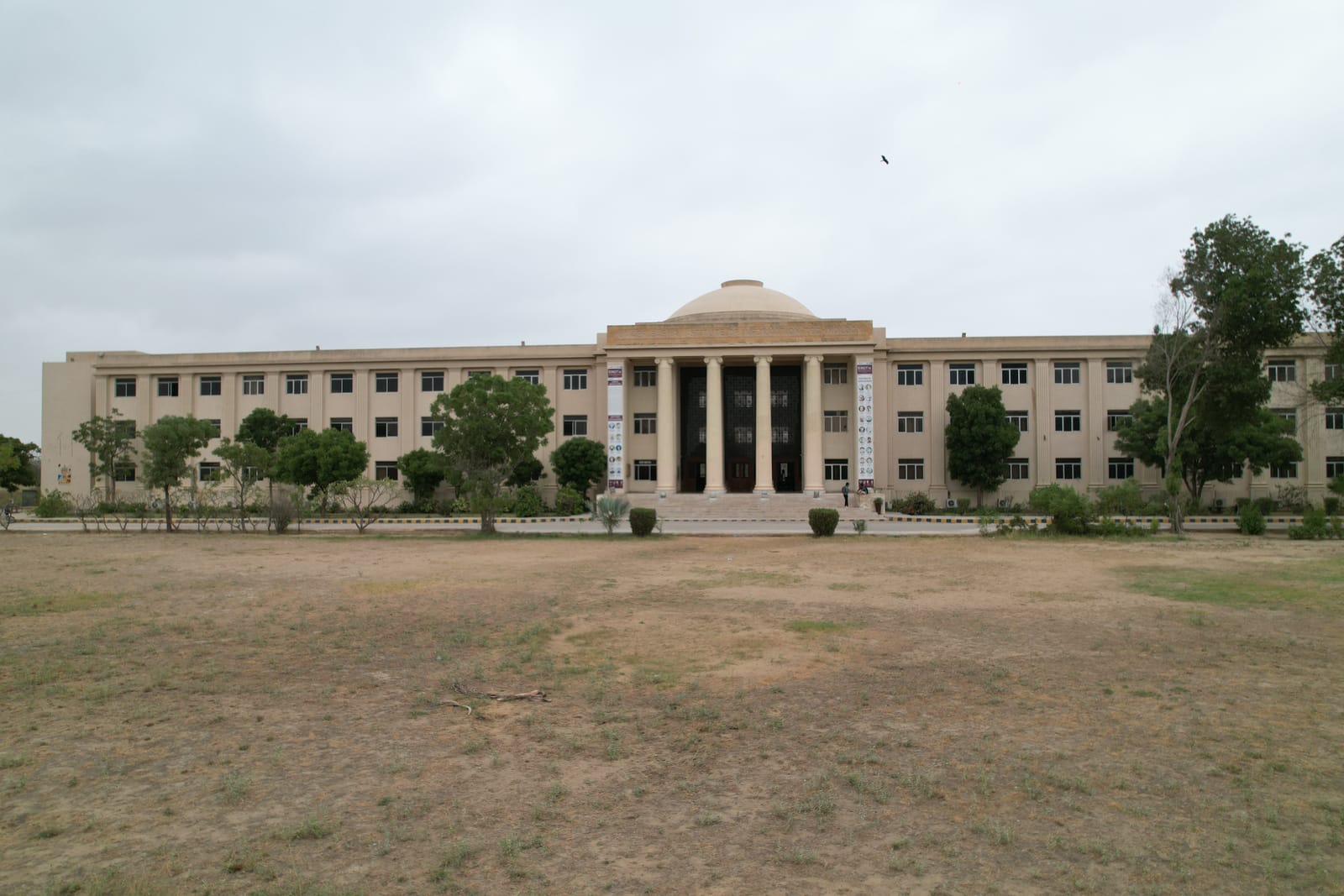
Our Vision
A Centre of Excellence in Higher Education
MCS
Master of Computer Science — the department's founding degree since 1985–86.
BS Computer Science
Four-year degree launched in 1996 (morning) and 2001 (evening self-finance).
MS & PhD
Two-year MS after BS, leading to doctoral research in Computer Science.
To become an internationally recognized Computer Science department as a Centre of Excellence in Higher Education where students receive high quality education. The Department of Computer Science offers a wide range of courses to provide opportunities for advanced study and research in Computer Science and Information Technology, producing highly skilled computer professionals for Pakistan and abroad. The Department maintains close links with professional organizations at national and international levels to enhance the academic standard of faculty and students alike.
Careers"To become an internationally recognized Computer Science Department as a Centre of Excellence in Higher Education where students receive high quality education."
Department Vision Statement UBIT

Career Opportunities
Excellent career opportunities exist for graduates of the Department of Computer Science — more than 80% are hired immediately by leading software houses and other institutions upon graduation. The Department also offers an evening Post Graduate Diploma (PGD) in Computer & Information Sciences for working professionals.
- Curriculum revised every two years to keep pace with developments in Computer Science and Information Technology.
- Designed per the recommendations of the Task Force on the Curriculum for Computer Science Programs for Sindh universities.
- Made comparable to international standards, matching the needs of the software industry.
Curriculum Policy
All curricula of the Department of Computer Science are developed for CS/IT on the policy that curriculum should be flexible and responsive to the changing structure of the market, encourage thinking, creativity and project-construction ability, and remain comparable with international standards — matching the needs of the next century by developing libraries, laboratories and, above all, teaching staff.

Introduction
Chairman: Dr. M. Sadiq Ali Khan (Assoc. Prof.)
 |
 |
Vision
To become an internationally recognized Computer Science Department as Centre of Excellence in Higher Education where students receive high quality education.
Introduction: The University of Karachi holds a unique position in the country's educational system. As a respected research and reaching institution, it is committed to intellectual leadership, and to excellence in both developing knowledge and conveying that knowledge to its students. The University of Karachi meets the commitments to preserve knowledge through its instructional and research programs for higher level education.
The Department of Computer Science, University of Karachi, was established by a resolution of Academic Council in its meeting, held on November 27. 1984, and it began functioning in the academic year 1985-86 by offering a Degree Program in Master of Computer Science (MCS) and become one of first institutions in Karachi imparting education in Computer Science and Technology. The Department also offers evening program leading to Post Graduate Diploma (PGD) in Computer & Information Sciences. In the year 1995; Department started MCS evening program, on self-finance basis, to cater the growing demand of professionally skilled manpower in the field of Computer Science.
To further strengthen the discipline of Computer Science by producing high quality pro with sound fundamental knowledge. the department has started in the year 1996 and 2001 BS (Computer Science) in the morning and evening, a four year degree program leading to MS (Computer Science), a two year program after completing the BS. MS programs leads to PhD (Computer Science) program. The University of Karachi has excellent supporting faculty in the subjects of Mathematics, Statistics, Physics and other allied subjects for teaching these courses at BS (Computer Science) level. The first batch of BS (Computer Science) of the morning program passed in 1999.
The Department of Computer Science offers a wide range of courses at various levels. The purpose of these courses is to provide opportunities for advanced studies and research in the field of Computer Science and information Technology and related fields, and also to produce highly skilled computer personnel to cater the need of Computer professionals in the country and abroad. The Department maintains high standard of education through continuous assessment and with periodic tests, quizzes, seminars and field projects. The Department maintains close link with professional organizations at national and international levels, to enhance professional and academic standard of the faculty and as well as of the students.
Curriculum Policy
The contents of courses offered are revised after every two years and books are recommended to cope with the rapid developments which are taking place in Computer Science and Information Technology. All the curricula have been designed in the light of recommendations of Task Force (on the Curriculum for Computer Science Programs for general Universities of Sindh). Thus all the curricula of Department of Computer Science are developed for CS/IT on the following policy:
"Curriculum should be made flexible so as to be responsive to the changing g structure of the market. The curricula shall encourage thinking, creativity and project construction ability. The curricula of CS/IT shall be made comparable with international standards and matching the needs of the next century by developing libraries, laboratories, and above all teaching staff".
Career Opportunities
Excellent career opportunities exist for the graduates of Department of Computer Science. More than 80% of graduates are immediately hired by top ranking software houses and other institutions.
Faculty
Full-Time Faculty Members
Associate Professors
Dr. M. Sadiq Ali Khan (Chairman) (H.E.C. Approved Supervisor)
Dr. Nadeem Mahmood
Assistant Professors
Mr. Badar Sami
Mr. Syed Jamal Hussain
Dr. Muhammad Saeed (H.E.C. Approved Supervisor)
Mr. Hussain Saleem
Dr. S. M. Khalid Jamal
Dr. Syed Asim Ali
Dr. Farhan Ahmed Siddiqui
Dr. Humera Tariq (S.L)
Dr. Humera
Mr. Mukesh Kumar Rathi Maheshwari
Mr. Taha Bin Niaz
Lecturers
Dr. Shaista Rais
Ms. Madiha Khurram
Ms. Maryam Feroz
- Mr. Badar Sami;
PhD (Candid), MCS(KU), B.Sc.
Assistant Professor
Languages, Software Development, Information Mgmt & Operating Systems
badarsami@uok.edu.pk - Mr. Syed Jamal Hussain;
MCS(KU), B.Sc.
Assistant Professor
Languages, Data Mining, Data Modeling
jamal@uok.edu.pk - Dr. M. Sadiq Ali Khan;
PhD (KU), MS (SSUET), BS (SSUET)
Associate Professor
msakhan@uok.edu.pk - Dr. Nadeem Mahmood;
Post. Doc. (IIU Malaysia), PhD (KU), MCS (KU)
Associate Professor
Temporal and Spatial Database Systems, Artificial Intelligence, Health Information Systems, Software Engineering
nmahmood@uok.edu.pk - Dr. Muhammad Saeed;
PhD (KU), MS (LUMS), BS (KU)
Assistant Professor
Operating Systems, Networking, Parallel Computing
saeed@uok.edu.pk - Mr. Hussain Saleem;
Ph.D (Candid), MCS( KU), BS (Electronics Engg, SSUET) MPEC
Assistant Professor
Software Project Management, Software Configuration Management
hussainsaleem@uok.edu.pk - Dr. S. M. Khalid Jamal;
Ph.D, M.Phil(C/Fi), M.B.A (KU), BS (KU)
Assistant Professor
Databases & DBMS, Grid/Cloud Computing, Data / Text / Web Mining & Knowledge Discovery, MIS, Information Extraction / Integration, Big Data Analytics, Social Media / Network Analysis
s.m.khalid@uok.edu.pk - Dr. Syed Asim Ali;
PhD (KU), M.A. (KU), BS (KU)
Assistant Professor
asim@uok.edu.pk - Dr. Farhan Ahmed Siddiqui; PhD (Comp. Sc.), MBA(KU), BS (SSUET), MCP, MPEC, MIEEE
Assistant Professor
farhan@uok.edu.pk
Computer Networks & Communication, WSN, Programming & OOP, Financial Accounting / Management - Dr. Humera Tariq;
BE, MCS, MS/PhD(KU)
Assistant Professor
Computer Graphics, Image Processing, Discrete Mathematics
humera@uok.edu.pk - Dr. Humera Bashir
Assistant Professor
Professional Member ACM, Member SIGGRAPH
Professional Member (OWSD), program unit of UNESCO
Departmetal Student Advisor
humera.azam@uok.edu.pk - Mr. Taha Bin Niaz; M.Engg. (NEDUET), BS (SSUET)
Assistant Professor
tniaz@uok.edu.pk - Dr. Shaista Rais
Lecturer
shaista.rais@uok.edu.pk - Ms. Madiha Khurram
Lecturer
madiha.khurram@uok.edu.pk - Ms. Maryam Feroze; MSCS (IBA), MBA (KUBS), BSCS(KU)
Lecturer
Teaching Associate / Teaching Assistant
- Ms. Farheen Faisal
- Mr. Zaeem Tariq
- Mr. Bari Ahmed
Inter-Departmental Faculty Members
- Dr. Muhammad Azhar Saeed
Department of Islamic Studies - Dr. Maqbool
Department of Islamic Studies - Dr. Tariq Khan
Department of Islamic Studies - Dr. Muhammad Sohail Shafiq
Department of Islamic History - Mr. Atteeq Razzak
Department of Mathematics - Ms. Hafsa Athar Jafree
Department of Mathematics - Dr. Noor Fatima
Department of Mathematics - Ms. Uzma
Department of Mathematics - Dr. Sheikh M. Zeeshan Iqbal
Department of Physics - Mr. Muhammad Ali Qureshi
Department of Physics - Prof. Dr. Farah Iqbal
Department of Criminology - Prof. Dr. Mudassir Uddin (Rtd.)
Department of Statistics
Visiting Faculty Members
- Professor Dr. S. M. Aqil Burney(IOBM) ;
Ph.D(UK), M.Phil.(KU), M.Sc.(KU)
Artificial Intelligence, Software Engineering, Optimization
burney@uok.edu.pk - Mr. Nadeem Ahmed, MCS;MS
(Data Communication, Networks, OS, Network Security)
- Engr. Ishfaque A. Khanzada; M.E(CE), BS(CE), CNSS, MCP, MCSA, MCSE, NSE1, NSE2, MPEC, MIEEE
(OS, Cryptography, Data Communication & Networks, ITCS) - Mr. Abdul Bari, MCS; MS/PhD(Candid)
Lecturer, Sheikh Zayed Islamic Center, UoK
(Databases, Temporal DBMS) - Mr. Farid Alvi
- Ms. Erum Shahid
- Ms. Binte Zehra
- Ms. Rabia Saadi
- Ms. Humaira Muzaffar
Compulsory Subjects
- Dr. Sohaila Farooqi, MA; PhD
Department of Urdu, University of Karachi - Dr. Tanzeem-ul-Firdous; PhD
Department of Urdu, University of Karachi - Dr. Rauf Parekh; PhD
Department of Urdu, University of Karachi - Dr. Naseer Akhter; PhD
Department of Usooluddin, University of Karachi - Dr. Obaid Ahmed Khan; PhD
Department of Usooluddin, University of Karachi - Dr. Abdul Jabbar Khan, Ph.D
Department of General History - Mr. Moiz Khan
Department of General History, University of Karachi - Mr. Asif Khan
Department of English, University of Karachi
Programs
Degree Programs Available
- BSCS. Computer Science (Morning / Evening)
- BSSE. (Software Engineering) (Morning / Evening)
- P.G.D.
- M.S. / Ph.D.
Evening Program
BSCS (Computer Science) - 110 seats
BSSE (Software Engineering) - 110 seats
P.G.D.
M.S.
B.S.
B.S Program
Mission (BSCS)
To strive for Excellence in Teaching & Research of Computer Science, is the opted mission. Educate students with the best practices of the field foster the development of problem solving and communication skills & ethical values providing quality teaching experiences through effective teaching methodology.
Curriculum (BSCS) Program :: Click here
Mission (BSSE)
The mission of the BS Software Engineering Program is to prepare software engineers for professional careers, advanced study, leadership roles and entrepreneurial endeavors through exposure to industrial practices, modern teaching and experiential learning that helps them to develop problem-solving skills so they can fully and ethically participate in a diverse society.
Curriculum (BSSE) Program :: Click here
Mission (BSAI)
The BS (AI) program gives the students an in-depth knowledge they need to transform large and complex scenarios into actionable decisions. The program and its curriculum focus on how complex inputs from the universe e.g. weather, galaxies, vegetations, human senses (vision, audio, smell, taste, touch), perceptions, actions, emotions, human biology, languages and various such disciplines in conjunction with databases are designed, processed and used to make logical decisions via queries, reasoning, automation and betterment of existing systems and environment. The curriculum of the BS (AI) program includes coursework in foundations of mathematics, linear algebra, statistics, computing, automated reasoning, modeling, case studies, machine learning, natural language processing, artificial neural networks, large language models using classical till contemporary generations of artificial intelligence models e.g. deep neural networks, graph neural networks, generative artificial intelligence. The program also encourages students to take courses in ethics and social responsibility, with the opportunity to participate in long term projects in which artificial intelligence can be applied to solve problems that can change the world for the better — in areas like agriculture, defense, healthcare, governance, transportation, e-commerce, finance and education.
Curriculum (BSAI) Program :: Click here
M.S. / Ph.D.
The BS (Computer Science) leads to MS (Computer Science) of two year duration with eight full courses each of 3 credit hours.
Course Work:
- All selected students will required to complete 8 courses (3+0 and/or 2+1) of 24 credit hours in two semesters.
- In each semester there will be 4 courses of 3 credit hours (3+0 and/or 2+1) each.
- The student has to pass the course work with CGPA 3.00 or more. In case the student fails to get the desired CGPA, he/she will be allowed to improve the grade. Only one chance for improvement will be given.
- At-least 75% attendance in the course work is compulsory.
- In case the candidate fails to get the required CGPA 3.00, a P.G.D. in the discipline will be given.
Semester-I |
||
| Course Number | Course Title | Credit Hours |
| MSCS-701 | Theory of Computation and Logic | 3+0 |
| MSCS-703 | Advanced Database Systems (ADS) | 2+1 |
| MSCS-705 | Parallel Computing : Hardware Systems (Optional) | 2+1 |
| MSCS-707 | Machine Learning Systems (Optional) | 2+1 |
| MSCS-709 | Topics in Computer Graphics and Image Analysis (Optional) | 2+1 |
| MSCS-711 | Applied Software Project Management (Optional) | 2+1 |
| MSCS-713 | Thesis (Optional) | 3 |
Semester-II |
||
| Course Number | Course Title | Credit Hours |
| MSCS-702 | Advanced Algorithmic Design and Analysis | 2+1 |
| MSCS-704 | Advanced Data Communication and Networks | 2+1 |
| MSCS-706 | Parallel Computing : Software (Optional) | 2+1 |
| MSCS-708 | Topics in Software Engineering : Formal Methods and Models (Optional) | 2+1 |
| MSCS-710 | Bayesian Networks and AI (Optional) | 2+1 |
| MSCS-712 | Data Mining (Optional) | 2+1 |
| MSCS-714 | Thesis (Optional) | 3 |
| MSCS-716 | Advanced Topics in AI (Optional) | 2+1 |
| MSCS-718 | Most Recent Trends and Developments in Software Engineering that are not covered by existing courses. IEEE's Software Engineering Notes, Relevant Periodicals, Journals will be used as course contents. (Optional) | 3 |
The specific areas and/or courses are:
Software Engineering, Database, Artificial Intelligence, Multimedia and Graphics, System Engineering, Computer Network and Computer Science education
Confirmation of Admission:
After passing the course work with CGPA 3.00, the student will apply through proper channel for confirmation of admission and approval of research title. The student will submit a synopsis along with research topic, bibliography, name of Research Supervisor and a copy of the marks certificate issued by the Semester Examination Section.Duration of Study:
The duration of M.S. or M.S./Ph.D. or Ph.D. program is as under:
a) M.S. Minimum 2 and maximum 5 years from the date of provisional admission.
b) Ph.D.
- Minimum 1 and maximum 5 years from the date of conversion from M.S. to Ph.D.;
- Minimum 2 years and maximum 5 years for those admitted directly to Ph.D.
- Students holding M.Phil without coursework (degree received before 2008) will be required to take 6 credit hours of PhD coursework (800 level). Supervisor may recommend additional courses.
Evaluation & Award of M.S. Degree:
The thesis will be evaluated by two experts and the supervisor. The viva voce examination will be conducted after receipt of positive reports from the experts and their approval by the BASR. On successful defense of the thesis, M.S. degree will be awarded.
Conversion to Ph.D.:
If the student passes the course work in CGPA 3.0 or more, he/she will be given a research project by the supervisor which will be processed through BASR. After one year of research, a student may apply for conversion from M.S./Ph.D. to Ph.D. through BASR.
Evaluation & Award of Ph.D. Degree:
- The student has to take two courses of the relevant subject of 3 credit hours (800 level) each.
- The candidate has to publish at least one research paper in any reputable journal during his /her research work.
- The thesis will be evaluated by two foreign experts and the supervisor. The viva voce examination will be conducted after receipt of positive reports from the experts and their approval by the BASR. On successful defense of the thesis, Ph.D. degree will be awarded.
Admission Test
The test comprise of 80 questions from following areas of Computer Science courses and 20 from English and General Knowledge. The areas of Computer Science includes the following subjects
- Artificial Intelligence
- Database
- Theory of Computer Science and Automata
- Computer Architecture
- Operating System
- Data Structure
- Algorithm analysis and Design
- Software Engineering
- Concepts of Programming Languages.
- Data Communication and Networking
- Mathematics and Statistics (According to BSCS (DCS-UoK) courses)
Download Sample Test Paper
U.B.I.T.
|
 |
The main objective of the UBIT is to impart quality education and conduct research in computer science and information technology. Through structured degree programs, intensive training courses for professionals, academicians, and researchers by organizing workshops and training courses. The main elements of the program focus on human research development in the field of IT. Specially designed research projects in computers, hardware & software engineering, IT, telecommunications software technologies, high tech data analysis techniques and modern trends in CS/IT. The UBIT complex is comprised of three blocks. The institute has state-of-the-art computer facilities and leased line circuits. There are several lecture rooms, discussion rooms, computer laboratories, and faculty offices. Rooms for holding teleconferencing, discussions, and training sessions are also provided for sessions on specialized topics. Library, administrative offices, filing room, prayer rooms, ladies common room also form a part of the UBIT establishment. The UBIT complex was completed in 2006. Some facts about the complex are as follows:
 |
Academic activities have already started at the UBIT on initiative of its director, Dr. Aqil Burney. After assuming the chairmanship of the department of computer science in March 2008, Dr. Burney did his utmost in facilitating the provision of basic academic necessities at the complex. It was due to his untiring efforts that classes of undergraduate and graduate levels are being conducted here. Moreover, UBIT is being used in parallel with the existing building of the DCS the reason being the presence of a strong infrastructure of academic activities that exists at the present building of DCS. At present, the department of Computer Science offers BS (Computer Science), BS (Software Engineering), MCS and MS/PhD programs. Besides these program conducted at the UoK campus, the department also conducts the Examination and Lab of BCS program of the affiliated colleges. As a result, the shifting is being conducted gradually as the academic and research facilities present at the UBIT is being strengthened with the passage of time.
Since the completion of the building and provision of labs and other facilities several seminars and workshops have taken place at the UBIT. These include a workshop on e-learning that was arranged with the coordination of Higher Education Commission under the supervision of Prof. Dr. S. M. Aqil Burney, Project Director, UBIT. The workshop was conducted by Intel Corporation.
 |
A seminar on “Cyber Crime & Associated Laws" took place at UBIT seminar hall. The keynote speaker was Mr. Khawaja Muhammad Ali CISA, Regional Coordinator (South), National Response Center for Cyber Crimes (NR3C), FIA.
Other than the seminars and workshops that have taken place at the UBIT, many dignitaries from government as well as from the academic world have visited the complex. These include people include Governor Sindh and Chancellor of the University of Karachi Dr. Ishrat ul Ebad Khan, former Chairman of HEC Dr Atta ur Rehman, governor monitoring teams; Scholars and specialists from several foreign countries including Korea, Italy, Singapore as well as from many universities of the country including LUMS, COMSATS, University of Sindh, Mehran University of Engineering and Technology and IBA-Sukkur
 |
M.C.S
Master of Computer (MCS) Syllabus
CS-501 : Fundamentals of Digital Computers Credit Hour (2+1)
Decimal and Binary systems, Binary addition, subtraction, multiplication and division Octal and Hexa decimal number systems.
Fundamental concept of Boolean Algebra. Basic laws of boolean algebra. De Morgan’s Theorem. Sum of the Products and Product of Sums expressions. Three input variable expression. Maps for simplifying expression.
Logical design. Binary counter. Integrated circuits. Medium and Large scale integration. Digital circuits. Diodes and transistors. Diods and circuits. Resistor transistor Logic. Diode-transistor Logic. Transistor Logic. Emitter-coupled Logic.
Input Output devices. Computer Organization. Addressing techniques, Index resistors. paging and indirect addressing. Single address microprocessor, two address computers.
Recommended Books :
- T.C. Bartee (1977). Digital Computer Fundamentals. 4th Edition. McGraw Hill.
- T.C. Bartee (1975). Introduction to Computer Science. McGraw Hill.
- O’ Mally (1971). Introduction to Digital Computer. Halt, Rinehart and Winston, New York.
- M.A. Harroson (1965). Introduction to Switching and Automata Theory. McGraw Hill.
- G. Birkhott and T.C. Bartee (1970). Modern Applied Algebra. McGraw Hill.
- Deem, Muchow and Zeppa (1974). Digital computers, Circuits and Concept. Reston Publising Company.
CS-502 : Automata Theory Credit Hour (3+0)
Set notation properties and operation. Relations, Properties of Relations, Equivalence of Relations, Closure of Relations, Graph and tree Notations.
Sequential circuits, Synthesis of Synchronous Sequential circuits. Transition diagram. Finite state machines. machines. Moore & Mealy machine. Capabilities & Limitation of finite state machine, state equivalence & Machine Minimization. Simplification of Incompletely specified machine. Interactive networks.
Fundamental Mode Circuits. State Assignment in Asynchronous Sequential circuits. Plus Mode Circuits.
State assignment using partitioning lattice of closed partitions over & generation of closed partitions. Information flow in sequential machines. Decomposition & Synthesis.
Experiments; Homing Experiments, Distinguishing Experiments Machine. Identification Experiment, Fault detection experiment. Design of diagnosable machine.
Finite memory machines, Definite machines, memory span w.r.t. output sequence information less machine.
Inert Linear Machine, Insert Linear Machine & rational. Transfer function, General Model Reduction of Linear Machines. Identification of Linear Machine, Application of Linear Machine to error correction.
Deterministic Recognizers, Transition Graph, Converting Non-deterministic to deterministic graphs. Regular expression. Transition graphs, Recognizing Regular sets, Regular sets corresponding to Transition graphs. Two way Recognizer.
Recommended Books :
- Zui-Cohavi. Sequential Circuits and Finite Automata Theory Tata. McGraw Hill.
- Abrahem Kendel, Fuzzuy Switching Automata; Theory and Application. Gamnee C. Lu.
- Arther Dfrje Dman Fremachandran R. Me. Theory and Design of Switching Circuits. John Willey & Co., New York.
CS-503 : Statistical Methods: Credit Hour (2+1)
Probability and Probability Distributions Discrete & Continuos. Bivariate Probability , & Bivariate Probability Distributions. Point estimation methods (using numerical methods), including simultaneous estimation of several parameters. Drawing simple and stratified samples from finite & infinite populations.
Recommended Books :
- C.H. Coulden (1980). Methods of Statistical Analysis.
- Parzen. (1981) Modern Probability Theory and its Applications.
- Haq, M. (1984) Foundation of Probability and Statistics. Tahir Sons.
CS-504 : Statistical Methods Advanced Credit Hour (2+1)
Interval estimation for different Probability Distribution parameters, using numerical methods. Testing of hypothesis. Application of Z, t, chi-square & F statistics. Test of goodness of fit, & test of independence in contingency tables.
Regression & correlation. multiple & partial correlation. Correlation ratio.
Analysis of variance, one, two three & four way classifications. Basic designs & their applications.
Recommended Books :
- C.H. Coulden (1980). Methods of Statistical Analysis.
- Parzen. (1981) Modern Probability Theory and its Applications.
CS-505 : Numerical Computing-I Credit Hour (2 + 1)
Finite deference’s, polynomial & factorial polynomials, operators, formulas of interpolation for equal & unequal intervals. Numerical differentiation..
Recommended Books :
- A. Ralston, P. Robinowitz. (1978). A First Course in Numerical Analysis.
- Francis Scheild. (1968). Numerical Analysis.
- L. F. Shampine, R. C. Allan, Jr. (1973). Numerical Computing : An Introduction.
CS-506 : Numerical Computing-I I Credit Hour (2 + 1)
Functional approximation by Minimum-Maximum Error Technique, non-linear equations, simultaneous linear equations, Matrix iterative methods.
Recommended Books :
- A. Rolston, P. Robinowitz. (1978). A First Course in Numerical Analysis.
- Francis Schield (1968). Numerical Analysis.
- F. Shampine, R. C. Allan, Jr. (1973). Numerical Computing : An Introduction.
CS-507 : Linear Programming Credit Hour (2+1)
Optimization 7 transportation problems. Simplex methods, theory & its applications. Degeneracy Problems. Duality theory and its ramification. Simplex method & transportation problem.
Recommended Books :
- Gruenberger, f. (1969) computing with BASIC Language. Cornfield Prezss. San Francisco.
- Kemeny, J. G. & Kurtz, T. E. (1971) Basic Programming, 2nd . ed. Wiley, N. Y.
- B.S. Gottfried (1975). Programming with BASIC McGraw Hills.
- Gruenberger, F. and G. Jaffary (1965) Wiley, N. Y.
CS-508 : Linear Programming Advanced Credit Hour (2+1)
Degeneracy & transportation tables. Generalized transportation problems.
Network flows, maximal flows in networks, primal-dual algorithm for transportation problems.
Production allocation & transportation, Machine assignment methods.
Input-Output analysis in Economics, using linear programming techniques.
Recommended Books :
- A Charness; W. W. Cooper & A. Handerson. (1953) An Introduction to linear Programming Wiley.
- G. Hadley (1969). Linear Programming Adduson-Wesley.
- Vajda (1956) The Theory of Games & Linear Programming Methueu.
- E. H. Bownan. (1965). Production Scheduling by the transportation method Linear Programming.
CS-509 : Programming Languages Credit Hour (2+1)
Introduction to data processing, systems of data storage Electronic data processing. Computer arithmetic, flow charts and programming techniques.
Programming in BASIC 7 FORTRAN, branching and looping, function 7 subroutines, matrices type of data files. Graphics.
Recommended Books :
- Gruenberger, F. (1969) Computing with BASIC Language. Confield Press. San Francisco.
- Kemeny, J. G. & Kurtz, T.E. (1971). Basic Programming, 2nd ed. Wiley, N. Y.
- B. S. Gottfried (1965) Programming with BASIC. McGraw Hills.
- Gruenberger, F. and G. Jaffary. (1965). Problems for Computer Solution. Wiley, N. Y.
CS-510 : Programming Languages Advanced Credit Hour (2+1)
Numbers, Arithmetic & Variables, Decision & Contract, loop control, Input types, Output types sets of variables, subprograms (basic & details), Logical values, character values, Magnetic tape Input Output.
Recommended Books :
- J. B. Moore, & L. J. Makela. (1978) Structure FORTRAN with WATFIV. Reston Publishing Co. Virginia.
- Cress, P; Darksen. P; Grham, J. W. (1970). FORTRAN IV, with WATIV Prinstorn Hall. Inc.
- Gotfried, B.S. (1972) Programming with FORTRAN-IV (1972). Quantum Publishers, N. Y.
CS-511 : Models and Inference Credit Hour (2+1)
Statistical models and random samples; informal methods of checking models; Estimation an prediction; Methods of Maximum likelihood and Least squares, and their applications within the frame-work of programming.
Recommended Books :
- M. Atiqullah. (1988). Basic Statistics with Computer Role. Kifayat Academy, Karachi.
- J. S. Milton & Jesse C. Arnold. (1986) Probability and Statistics in the Engineering and Computer Science. McGraw Hill.
CS-512 : Advanced Assembly Language Credit Hour (2+1)
Fundamental concepts, Machine language, Registers, addressing, Relative addressing, machine language instruction Formats. Assembly language. Symbolic coding and assembly systems. Macros. Defining storage and defining constants. Program loops. Code Conversion. Subroutines and subroutine linkage. Parameter passing techniques. Input/Output considerations. System and utility program. Interrupts. Operating system concepts. The instruction set. Program design. Documentation. Debugging. testing & maintenance.
Recommended Books :
- Alan R. Miller (1987). Assembly language Techniques for IBM PC. Sybex Inc. U.S.A.
- George W. Gorline (1987). Assembly and Assemblers. prentice Hall.
CS-513 : Computer Architecture Credit Hour (2+1)
Architecture Attributes, Organization Attributes, Architectural Development (History), Machine Compatibility v/s Program Behavior. Flynn’s Classification of Computer Architecture (SISD, SIMD, MISD, MIMD Architectures), Shared v/s Distributed Memory Architecture under MIMD classification, Tightly coupled and Loosely couples systems, Bernstein’s conditions. Two state logic, Performance measurement of commuter system (MIPS, MFLOPS and Throughput calculations), Common bus architecture, Logic families and their characteristics (TTL, MOS & ECL), Interfacing of various logic families. Difference b/w Microprocessors and Microcontrollers architectures, Open Architecture v/s Close Architectures, CISC, RISC, Single Task & Super-Scalar (K-Issue) Processors, WINTEL Architecture. CPU performance factors (1. Clock-speed, 2.Bus-sizes, 3.Numeric processors, 4. Micro-Code efficiency, 5. Cache Memories, L1,L2,L3), Pentium Cache Organization, Pipeline Architectures. Designing of Program-Counter, Memory Address Register, Instruction Register, Control Unit (Control Matrix, Microprogrammed), ALU, etc. Micro v/s Macro Instructions. Development of Assembly language. Variable Machine Cycles.
Recommended Books :
- M.Moris Mano. Computer System Architecture.
- William Stalling. Computer Organization and Architecture.
CS-514 : Discrete Mathematics Credit Hour (3+0)
Sets, Combinatorics, Sequences, Formal logic, Propositional and predicate calculus, Methods of Proof, Mathematical Induction and Recursion, loop invariants, Relations and functions, Pigeon whole principle, Trees and Graphs, Optimization and matching.
Recommended Books :
- Discrete Mathematics and Its Applications, by Kenneth H. Rosen (Fifth Edition) McGraw-Hill Science/Engineering/Math, Released: 09 September, 2002 - ISBN: 0072424346
- Discrete and Combinatorial Mathematics, by Ralph P. Grimaldi (Fifth Edition) Rose-Hulman Institute of Technology, Publisher: Addison-Wesley Published: 07/17/2003, ISBN: 0-201-72634-3
CS-601 : Data Base System Credit Hour (2+1)
Basic concepts: Storage Structure; Data Structure and corresponding operators; on Different approaches. Relational Data Structure ; System R Architecture; Data Structure of System R; Data Manipulation; EMBEDDED SOL; The External level of System R; The Internal level of System R; Query by Example; Relational Algebra; Relational Calculus; Further Normalization..
The Architecture of an IMS System (Information Management System) IMS Data Structure, The External level of IMS: IMS Data Manipulations The Internal level of IMS: IMS logical Data base; IMS Secondary Indexing: IMS fast path data base. The Architecture of a DBTG: DBTG Data Structure; The External level of DBTG Data Manipulation.
United Data base Languages; A comparison of the Relational and Network approaches.
Recommended Books :
- C. J. Date. And introduction to Database System . John Wiley & Co., New York.
CS-602 : Structured Programming Credit Hour (2+1)
Logical Commentary in Structured Programming, Logical Commentary in Stepwise abstraction.
Verifying Structured programs, correctness of Structured and prime Programs. Trace tables for proving program correctness, Disjoined rules, Verifying Fardo Programs, Loopinvariants. Inventing Structured programs, programming by stepwise refinement and by stepwise reorganization, Detailing and Design.
Recommended Books :
- Strunk, W & E. B. White (1972) The Elements of Style McMillan New York.
- Chang, C & R. C. Lee (1973). Academic Press, N. Y.
- Burge, W. H. (1975) Recursive Programming Techniques Reading Mass: Addison Wesley.
- Linger, R. C : H. D. Mills & Witt, B. I : (1979). Structure Programming Addison-Wesley.
- Haperoft. J.E : & J. D. Ullman. (1969). Formal Languages and their Relation to Automata Reading Mass: Addison- Wesley.
CS-603 : Operations Research Credit Hour (2+1)
Elements of Dynamic Programming. Model & its application. Dimentionality in Dynamic Programming Model. Methods & Applications of Integer Programming. Deterministic Inventory Models. Poison Queuing Models.
Recommended Books :
- H. A. Taha. (1980). Operation Research, An Introduction.
- Kauf Man. (1979). Methods And Models of Operation Research.
- Hillier & Lieberman. (1979). Introduction to Operation Research.
- Churchman, C. V; R. A. Cheff; E. L. Arnoff: (1980). Introduction to Operation Research.
- Saaty. (1980). Mathematical Methods of Operation Research.
CS-604 : Operations Research Advanced Credit Hour (2+1)
Introduction to Matrix Algebra. Sets, functions, convex sets. Applied Linear Programming. Simplex Method & its development.
Dual Problem & post Optimality Analysis. Transportation Problems. Advanced Linear Programming & Parametric Programming.
Recommended Books :
- H. A. Taha: (1980). Operation Research, An Introduction.
- Kauf Man. (1979). Methods And Models of Operation Research.
- Hillier & Lieberman. (1979). Introduction to Operation Research.
- Churchman, C. V; R. A. Cheff; E. L. Arnoff: (1980). Introduction to Operation Research.
- Saaty. (1980). Mathematical Methods of Operation Research.
CS-605: Digital and Analog Computers and Servo-Mechanism Credit Hour (2+1)
DIGITAL COMPUTERS:
Introduction to digital computers, Boolean algebra Binary counting. Logical circuit. Gates, AND, OR, NOT, NAND , NOR, Evaluation of Logical diagrams. Flip Flop, RS & JR Flip Flop. Memory circuits Clock. DTL, TTC and ECC.
ANALOG COMPUTERS:
Operational Amplifier, Solution of equation, Operational Amplifier difference between Digital & Analog computers. Computer mechanism, Computer Language. Programming (outlines). Key puncher etc.
SERVO MECHANISMS:
Open loop & closed loop regulators, Types of servo, Regulation Error detectors, Error correctors, Transducer Amplifiers, Negative feed back amplifier theory. Servo diagram transfer function, Servo methods.
Recommended Books :
- T.C. Bartee: (1977). Digital Computer Fundamentals McGraw Hill. N . Y.
CS-606: Decision Theory Credit Hour (2+1)
Loss function. Risk & Average Loss. Class of admissible functions. Minimax principles & its application to numerical problems consisting of several variables. Linear & quadratic losses & their cases to multivariate cases.
Prior distributions. Bayes decision procedures. Posterior distributions, Numerical computation of these distributions.
Recommended Books :
- Chackol G: (1972). Computer-Aided Decision Making. American Elsevier, N. Y.
- Raiffa & Scheffler: (1977). Decision Theory.
CS-607: Numerical Computing Advanced-I Credit Hour (2+1)
Numerical Integration. Solution of ordinary differential equation. Approximation of function by least square methods.
Recommended Books :
- Ralston, P. Robinowitz: (1977). A First Course in Numerical Analysis.
- Francis Scheid: (1968). Numerical Analysis.
- L. F. Shampine, R. C. Allen, Jr. : (1973). Numerical computing.
CS-608: Numerical Computing Advanced-II Credit Hour (2+1)
Matrix Inversion techniques, Simplex method for solving linear programming problems, Eigen Vectors of matrices.
Recommended Books :
- A. Ralston, P. Robinowitz: (1977). A First Course in Numerical Analysis.
- Francis Scheid: (1968). Numerical Analysis.
- L. F. Shampine, R. C. Allen, Jr. : Numerical Computing.
CS-609: Introductory Computer Simulation Credit Hour (2+1)
System models. Principles of System Modeling. Simulation study. Discrete event simulation. Multiqueue & Multiserver models Queuing Statistics & its bias.
General purpose simulation system & its organization, (GPSS) Random distribution.
Indirect addressing, Looping, Save values, Tabulation debugging Statements.
Sim-script & its organization, events, variables, Temporary entities, Grouping entities in sets. Transfer & conditional statements. input/output in Simscript & Statistical calculation. Subprogram.
Recommended Books :
- F. J. Maryanski: (1980). Digital Computer Simulation Hayden Book Company, New Jersey.
- Gorden, G: (1975). The Application of GPSS to Discrete System Simulation. Prentice Hall.
- ACH Simulattor, Vol,. 7. No 1, January 1976.
- Fishman, G. S. : (1973). Concepts and Methods in Discrete Event Digital Simulation. N. Y. Wiley.
- Chao, L. L. :(1969). Statistics: Method and Analysis. McGraw Hill.
- Goldstein, R. B: (1973). “Chi-square Quantiles”, Algorithm 451, Communications of the ACM, Vol. 16, No. 8.
- Hildebrand, F. B: (1956). Introduction to Numerical Analysis. McGraw Hill.
- Horn Beck, R. W: (1975). Numerical Methods. Quantum Pubishers.
CS-610 : Applications of Computer Simulation Credit Hour (2+1)
Probability density functions and distribution functions. Conditional and joint probability, distributions. Statistical independence. Independence and Correlation.
Random numbers, Generation of random numbers, Generation of discrete and continuous probability distributions Uniformity and independence of random numbers. Generation of Exponentially distributed and normally distributed random numbers.
Analysis of simulation experiments. Estimation of parameters in probability distributions,from values generated by simulation.
Recommended Books :
- F. J. Maryanski: (1980). Digital Computer Simulation Hayden Book Company, New Jersey.
- Gorden, G: (1975). The Application of GPSS to Discrete System Simulation. Prentice Hall.
- ACH Simulattor, Vol,. 7. No 1, January 1976.
- Fishman, G. S. : (1973). Concepts and Methods in Discrete Event Digital Simulation. N. Y. Wiley.
- Chao, L. L. :(1969). Statistics: Method and Analysis. McGraw Hill.
- Goldstein, R. B: (1973). “Chi-square Quantiles”, Algorithm 451, Communications of the ACM, Vol. 16, No. 8.
- Hildebrand, F. B: (1956). Introduction to Numerical Analysis. McGraw Hill.
- Horn Beck, R. W: (1975). Numerical Methods. Quantum Publishers.
CS-611: System Analysis & Design-I Credit Hour (2+1)
Introduction to System Analysis/Design, Techniques in Data Processing applications. Feasibility Investigation, Feasibility Report, (Investigation, models, designs, effectiveness procedures) System Layout, Preparation and handling of Data. Data specification File organization, File specifications, System Flowcharts, Programming techniques, Program specification, Test-Data, System Test, Systems Projection. System’s Implementation, Maintenance and Review, Case study.
Recommended Books :
- Robert J. Thierlouf: System Analysis & Design, “A Case Study Approach”/ Charless Merrill Publishing Company.
- Andrew Parbiu: System Analysis.
- John M. Fitz, Gerald Andra F., Gerald : Fundamentals of System Analysis. John Wiley & Sons Publishing Company.
CS-612: System Analysis & Design-II Credit Hour (2+1)
Project. Designing a system.
Recommended Books :
- Robert J. Thierouf: System Analysis & Design, “A Case Study Approach”/ Charless Merrill Publishing Company.
- Andrew Parbiu: System Analysis.
CS-613 : Operating System Credit Hour (2+1)
Generation operating systems. Early history & future trends. Hardware, Software and Firmware. Process Management: Process concepts, Asynchronous concurrent processes. Monitors & the ADA redezvou; Deadlock. Storage management: Real storage, Virtual storage organization. Processor Management: Job and processor schedule, multiprogramming. Auxiliary storage management: Disk scheduling, file & database system. Performance measurement, monitoring & evaluation, Analytic modeling, Networks & security: Network operating system & operating system security. Case studies: UNIX system, VAX, CP/M, MVS, VM.
Recommended Books :
- H. M. Deitel. (1986). An Introduction to Operating System. Addison-Wesley.
- William s. Davis. (1985). Operating System. Addison-Wesley.
- Lubomir Bic. (1987). Logical Design of Operating System 2/D. Prentice Hall.
CS-614: Advanced COBOL Programming Credit Hour (2+1)
An Overview of structured programming techniques. Structure of COBOL Programs. Records, Files & Table handling. Sequential, Indexed sequential and Relative File Processing. Sorting & Merging Files. Subprograms & Nested Programs. Other advanced COBOL features.
Recommended Books :
- A. S. Philippakis Leonard J. Kazmier. (1986). Structured COBOL. McGraw Hill.
- A.S. Philipp;kis Leonard J. Kazmier. (1986). Information system through COBOL. McGraw Hill.
CS-615: Software Engineering Credit Hour (2+1)
Introduction to Software Engineering, Software requirements, Planning and design concepts. Software Lifetime, Software maintenance, Software Engineering for Projects, A Life cycle approach to software engineering. Software tools, Structured Programming, Software fault tolerance, Project support libraries.
Recommended Books :
- Richaro E. Fairley. (1987). Software Engineering Concepts. McGraw Hill Book Co.
- Doug Bell & Ian Morrey. (1988). Software Engineering A Programmer’s Approach. Prrentice Hall.
- Michael S. Deutsch & Ronald R. Willis; (1988) . Software Quality Engineering. Prentice Hall.
CS-616: Artificial Intelligence Credit Hour (2+1)
Introduction to Artificial intelligence, Artificial intelligence methods & techniques, Problems & Problem solving methods, Production system, Control Strategies, Heuristic Search & functions, Knowledge representations & the frame Problem.
Recommended Books :
- D. Cohen & E. A. Feigenbaum. (19870. Hndbook of Artificial Intelligence’s. Pitman Books, London.
- A. Bonnet & Jack Howlett. (1985). Artificial Intelligence. Prentice Hall International.
- Elaine Rich. (1987). Artificial Intelligence. McGraw Hill.
CS-617: Expert Systems Credit Hour (2+1)
Introduction to expert systems, Heuristic search, The architecture of expert systems, Components of an expert system, The socials impact of expert systems, Evaluating an expert system, Fuzzy reasoning systems, How to build an inference engine, Knowledge engineering, Machine Learning strategies, Natural language interface, Formal and Informal methods, TURBO PROLOG
Recommended Books :
- Richard Forsyth. (19870. Expert Systems. Chapman and Hall.
- A. Bonnet, J. P. Hoton, J. M. Troung-Ngoc. (1988) Expert Systems. Prentice Hall International.
- Daniel H, Marcellus.(1988) Expert Systems Programming in TURBO Prolog. Prentice Hall.
CS-618: Computer Graphics Credit Hour (2+1)
Introduction to Computer Graphics. Line & dot oriented graphic equipment’s. Curve drawing. Two-dimensional, graphic objects, transformations and Graphic algorithms, 3-D, graphics objects, Transformations and Graphic algorithms. Graphic Software packages for 2-D and 3-D. Graphic languages and Computer graphic standard. Applications to different fields.
Recommended Books :
- John Rankin. (1987). Computer graphics, Software Construction. Prentice Hall Internationals.
- Goorger Marshall. (1987). Computer grtaphics in application.. Prentice Hall International
- Harrington.(1988). Computer graphics A programming Approach. 2/e McGraw Hill.
CS-619: Microprocessor and Applications Credit Hour (2+1)
Structure of Microprocessor; Technical data; Programming Model; Data type; Register; Processor status register. Bus system; Processor signal; Introduction to Programming and data transfer; Data Manipulation; Transfer of Control & Programming technique; Digital I/O; interrupts; Various application of Microprocessors.
Recommended Books :
- Fred Halsall, Paul Lister, Richard Schmitt and Louis L. Covert. (1986). Microprocessor Fundamentals. Johbn Willey & Sons.
- Edward J. Pashow. (1986). Microprocessor Technology & Microcomputers. McGraw Hill.
- S. J. Cahill. (1985). Designing Microprocessor-Based Digital Circuitry. Prentice Hall.
- John E. Uffenbeck. (19870. Microcomputers and Microprocessors Interfacing and Troubleshooting. Prentice Hall.
CS-620: Compiler Construction Credit Hour (2+1)
Introduction to Compiler theory; Syntactical specifications, grammar and languages; Terminology in programming analysis, Lexical analysis; Top-down and bottom down techniques; table techniques optimization and organization; Regular expression and finite state techniques; Storage organization and dynamic storage allocation; Symbol tables, semantic routines, error recovery, interpreters and load optimization; Intermediate code generation and optimization; One pass Compilation techniques; Object condes for subscripted variables storage mapping functions and Compilation of sequencing statements; mapping functions and Compilations; Detailed organization of a simple Complete Compiler.
Recommended Books :
- Brinch Hansen/(1987). Compiler Design. Prentice Hall.
- Tremblay. (1987). Theory & Practice of Compiler Writing. McGraw. Hill.
CS-621: Graph Theory Credit Hour (2+1)
Basic definitions and representations of linear graphs; Cycle structures; Equivalence and mapping. Connectivity and independence; Planar graphs and Hamilton graphs; Graph Coloring; Combination theory and graphs.
Recommended Books :
- Tremblay & Manoher. (1987). Discrete Mathematical Structure with application to Computer Science. McGraw Hill .
- Even, Shimon (1973). Algorithmic Combinatrics. Macmillan Company.
- Harary.F; R.Z. Norman and D.Certwright (1965). Structural Model introduction to the theory of Directed graphs. John Wiley & Sons.
CS-622: Data Communication and Networks Credit Hour (2+1)
Introduction to data Communication; Communication organization; Problems in the scientific, engineering and data processing environment; The behavioral basis of data communication; Synchronous and asynchronous transmission; Beseband and analogue signaling techniques and channel capacity; Modulation techniques, communication Media. error Control; Introduction to computer networking; line switched and message switched type networks; Pocket switching, circuit switching, satellite and local networks; Link-capacity, average message length, traffic flow etc. for networks; introduction to centralized networks, time delay and cost trade-offs.
Recommended Books :
- Uyless Block. (1987). Data Communication & Distributed Network. Prentice Hall.
- Brenden Tangney & Donal O. Mahony. (1987). Local Area Networks and their applications. Prentice Hall.
CS-623: Data Structures and Algorithm Analysis Credit Hour (2+1)
Introduction to Complexity Analysis, Sorting and Searching Algorithms and their complexity analysis. Arrays and Linked Lists, Stacks and Queues and their applications, Hash tables, hashing functions. Introduction to NP, NP hard and NP Complete Problem. Trees (N-Ary, Binary search, AVL, Splay etc) and their operations (insertion, deletion etc), tree traversals and their applications, Binary Search Tree Balancing, Graphs, topological sort, shortest path and all-pairs shortest path algorithm and their comparisons. Minimum spanning trees, Dynamic Programming, Greedy Algorithms, Approximation Algorithms
Recommended Books :
- Thomas H. Cormen, Charles E. Leiserson, Ronald L. Rivest & Clifford Stein, “Introduction to Algorithms” Second Edition, MIT Press Released 01 September, 2001 - ISBN: 0262032937
- Mark Allen Weiss,"Data structures and algorithm analysis in C/C++", Addison-Wesley Publishing Company (1994)
CS-624:Object Oriented Analysis and Design Credit Hour (2+1)
The need for Object Oriented Analysis and Design, Introduction of Unified Processes, Understanding User Requirements, Introduction to the Case Study that should be followed throughout the course to explain each phase and their artifact, Use Cases, Conceptual Model, System Sequence Diagrams, Domain Model, Refining Domain Model, Contracts, Collaboration Diagrams; Sequence Diagrams, Use Case Realizations, Design Class Diagram, Design Patterns, Application of Design Patterns (GRASP and some GOF patterns), Design Class Diagrams- From Design to Implementation.
Recommended Books :
- Craig Larman,"Applying UML and Patterns, An introduction to Object Oriented Analysis and Design", Prentice Hall, 2002
- Simon Bennet, Steve McRobb, "Object Oriented Systems Analysis and Design Using UML (Second Edition )" McGraw-Hill, 2002
- Timothy C. Lethbridge and Robert Laganière, "Practical Software Development using UML and Java", McGraw Hill, 2001
625/626: Data Warehousing and Data Mining Credit Hour (2+1)
Introduction to Data Warehousing- Heterogeneous information, the integration problem, the Warehouse Architecture, Data Warehousing, Warehouse DBMS. Aggregations- SQL and aggregations, aggregation functions, grouping. Data Warehouse Models and OLAP Operations- Decision support, Data Marts, OLAP vs OLTP, the Multi-Dimensional data model, ROLAP vs MOLAP, Star and snowflake schemas, the MOLAP cube, roll-up, slicing, and pivoting. Data Warehouse Design- monitoring, wrappers, integration, data cleaning, data loading, materialised views, warehouse maintenance, OLAP servers, metadata.
Introduction to Data Mining- A View of the KDD Process, Problems and Techniques, Data Mining Applications, Prospects for the Technology. Data Mining Inputs and Outputs- Concepts, Instances, Attributes; Kinds of Learning, Kinds of Attributes, Preparing Inputs. Knowledge Representations, Decision Tables and Decision Trees, Classification Rules- Association Rules, Regression Trees and Model Trees, Instance-Level Representations. Data Mining Algorithms- One-R, Naïve Bayes Classifier, Decision Trees, Decision Rules, Association Rules, Regression, K-Nearest Neighbour Classifiers. Time series data analysis, Text mining, Web Mining. Evaluating Data Mining Results.
Recommended Books :
- Paulraj Ponniah, "Data Warehousing Fundamentals",John Wiley & Sons, 2001.
- Ralph Kimball, ""The Data Warehouse Lifecycle Toolkit: Expert Methods for Designing, Developing and Deploying Data Warehouses", John Wiley & Sons, 1998.
- Mehmed Kantardzic," Data Mining: Concepts, Models, Methods, and Algorithms", John Wiley & Sons, 2003.
- Jiawei Han and Micheline Kamber, "Data Mining: Concepts and Techniques", Morgan Kaufmann Publishers, 2001.
CS-691 :
CS-692 : M.Sc. Thesis : (Credit Hour 6 )
For only those who secure first class and pass all courses in M.Sc. (Prev) Examinations.
CS-693 : Project : (Credit Hour 3 )
For only those, who have passed all the courses of the last three semesters.
B.C.S. Course outline
B.C.S. (Three Year) Course Outlines
The courses are briefly outlined here along with credit hours and pre-requisites for each course.
The curriculum comprising of both hard–core computer science courses and supporting courses has been designed to achieve academic excellence and in-depth knowledge in different areas of computer science.
The outline given under each of the courses indicates the minimum coverage of each course. Changes and advancements taking place in different areas are reflected in the course contents and individual instructors do regular additions.
Classification of courses
The program is divided into three types of courses provide the basis of academic and practical understanding of different areas of Computer Science.
Essential Courses
These are mandatory courses prescribed by the University of Karachi for all degree programs. Each of the following courses are of 3 credit hours, contributing a total of 9 credit hours.
0101 ENGLISH
Credit-hours : 3
Contact hrs : Lectures 3
Pre-requisite : Nil
Contents of course as prescribed by the University of Karachi.
0102 PAKISTAN & ISLAMIC STUDIES
Credit-hours : 3
Contact hrs. : Lectures 3
Pre-requisite : Nil
Contents of course as prescribed by the University of Karachi.
0103 HUMANITIES & SOCIAL SCIENCES
Credit hours : 3
Contact hrs : Lectures 3
Pre-requisite : Nil
Contents of course as prescribed by the University of Karachi.
Minor Courses
Minor courses provide foundation in Mathematics, Statistics and Physics, essential for the development of basic concepts of computer science. Each of the minor courses are of 4 credit hours contributing a total of 32 credit hours.
1101 CALCULUS I
Credit-hours : 4
Contact hrs. : Lectures 4+ Tutorials2
Per-requisite : Nil
Functions and graphs Linear equations and system of linear of linear equations: Grammar’s rule; Conic section; Sequences; Limits and continuity; Differentiation; Chain rule; implicit Differentiation; differential applications; Rolle’s and Mean value thereoms; Maxima/Minima; Graph sketching; L’Hospital’s rule; lntegration as limit of sum;integration of simple functions; Real and complex Numbers.
1102 CALCULUS II
Credit-hours : 4
Contact hrs. : Lectures 4 Tutorial 2
Pre-requisites : (1101)
Techniques of integration : Area between curves; Continuity of function of several variables; Partial differentiation; Directional derivations; Line integral; Multiple integrals; Gauss’s Stoke’s and Green’s theorems; calculus of variations.
1103 PHYSICS I
Credit-hours : 4
Contact hrs. : Lectures 4+Tutorials 2
Pre-requisites : Nil
Vectors; Oscillations; Wave motion; Sound waves; Electrostatics and field Concepts; Electromagnetic Induction; Electromagnetic waves; Electrical conduction in conductors and semiconductors; Network Analysis.
1104 PHYSICS II
Credit-hours : 4
Contact hrs. : Lectures 4, Tutorials 2
Pre-requisite : (1103)
Photoemission; Photoconduction; Luminescence; Ferroelectrics; Lasers; Optoelectronics; Optical fibers; Superconductivity; Semiconductor Diode Applications; BJT and FET,their characteristics and Biasing.
1105 PROBABILITY AND STATISTICS
Credit-hours : 4
Contact hrs. : Lectures 4, Tutorials 2
Pre-requisite : Nil
Basic concepts of statistics; Sample space, events, classical and axiomatic definition of probability; Conditional probability and Bayes theorem; Binomial, poison and Normal distributions; Moment generating functions; limit theorem; Sampling theory; Estimation methods; Points and interval estimations; Estimating proportions and tests; Linear regression; Correlation’s and regression analysis.
1201 BASIC ELECTRONICS
Credit-hours : 4
Contact hrs. : Lectures 4, Tutorials 2
Pre-requisite : (1104)
Amplifiers, Op-amps and its circuits, Logic families, Oscillators, Active filters, Voltage regulators, IC fabrication, AM and FM modulations; Receivers and transmitters, Digital communication, Radio-wave propagation, Antennas.
1202 LINEAR ALGEBRA AND DIFFERENTIAL EQUATIONS
Credit-hours : 4
Contact hrs. : Lectures 4
Pre-requisite : (1102)
Linear algebra, Vector spaces Subspaces Bases and dimensions; Linear transformations; Rank and nullity; algebra of matrices; Inverse of a matrix; Determinants; Eigen-vectors elementary theory of differential equations with constant coefficients.
1203 STATISTICAL METHODS AND INFERENCING
Credit-hours : 4
Contact hrs. : Lectures 4
Pre-requisite : (1105)
Estimation methods; Tests of hypotheses; Multiple linear linear regression; Correlation and regression analysis; Stochastic processes; Stationary and Markov processes; Decision theory; Large sample theory.
Major/Elective Courses
These courses are designed to develop concepts and enforce comprehension in different areas of Computer Science. Some of these are hard-core and the rest are by selection form a vast variety, depending on the student’s interest and the availability of faculty.
A minimum of 60 credit hours should be completed.
2101 INTRODUCTION TO COMPUTER PROGRAM
Credit-hours : 4
Contact hrs. : Lectures 4
Pre-requisite : (1105)
Computer’s cultural impact, history, uses; Essential features of systems; problem analysis; Development of basic algorithms; Introduction to a high level language with general applications, Programming assignments
2102 INTRODUCTION TO COMPUTER SCIENCE
Credit-hours : 3
Contact hrs. : Lectures 3, Tutorials 2, Practical 6
Pre-requisite : (2101)
Organization, logical design and components of digital computers; Methods of computer usage in the areas mathematical science; Algorithm development and presentation; Boolean algebra; Machine representation of characters; Flow of controls; Arithmetic and logical operation; Machine control; input/output; Basic number codes; Overview of computer systems; Programming assignments.
2201 DIGITAL COMPUTER LOGIC
Credit-hours : 3
Contact Hours : Lectures 3, Consultancy 2
Pre-requisite : (2102)
Introduction to switching logic and combinational circuits; Minimization techniques; Karanugh map and Quine-McClusky methods; Half adders and full adders; Combinational circuits using MSI and LSI components; Adders, comparators, decoders, mutliplexors, ROMs and PLA; Synchronous and asynchronous sequential circuits, registers, counters, etc. Introduction to micro programming.
2202 DISCRETE STRUCTURES
Credit-hours : 3
Contact Hours : Lectures 3, Consultancy 2
Pre-requisite : (1102/2102)
Fundamental algebraic, logical and combinatorial concepts such as: set algebra, partition relational algebra; algebraic structures algorithmic closure, groups and semi-groups; Boolean algebra and propositional logic, finite state machines, regular expressions; Elements of the theory of directed and undirected graphs; Finite state machines; homomorphism, realization; Reachability, Applications of these structures to various areas of Computer Science.
2203 COMPUTI NG METHODS I
Credit-hours : 3
Contact Hours : Lectures 3 Practical 2
Pre-requisite : (1102/2102)
Error concepts and analysis, solutions of nonlinear equations by various methods e.g. inter-halving, linear interpolation. Newton, fixed point, Q-D Muller, etc. Interpolating polynomials; various types of differences; Representation of polynomials by differences; Operators and their relation; Symbolic derivation; Interpolation with unequal intervals; Inverse interpolation; 2 and 3 dimensional interpolation; Numerical differentiation and Integration. Solution of systems of Linear Equations by various methods.
2204 DATA STRUCTURES AND APPLICATIONS I
Credit-hours : 3
Contact Hours : Lectures 3 Consultancy 4
Pre-requisite : (2102 & 2202)
A detailed study of the basic structures commonly used in data processing Techniques for data manipulation in structures such as stacks, queues, linked lists of trees graphs, management of memory space and overflow, internal sorting external sorting and hash table methods; Searching and merging files, emphasis is on design implementation and evaluation of various programming assignments.
2205 INTRODUCTION TO OPERATING SYSTEMS
Credit-hours : 3
Contact Hours : Lectures 3 Consultancy 2
Pre-requisite : (2102)
Software organization; Translation, linkage, loading and executing; Control programs for batch processing, time sharing and real time application; Accounting; Communication between program units; Multiprogramming and multiprocessing systems; Addressing techniques, paging and memory management, Control of parallel input/output processing, buffers and interrupt facilities, File systems and protection; Detailed analysis of a small system case study.
2206 ASSEMBLY LANGUAGE PROGRAMMING
Credit-hours : 3
Contact Hours : Lectures 3 Practice 6
Pre-requisite : (2102)
Digital computer organization, machine language, instruction execution, addressing techniques, digital representation of data, symbolic coding and assembly systems; Macrros; Conditional assembly; I/O control subroutine linkage; System and utility programs, programming techniques; Facilities of operating systems; Large number of programming assignments on mainframe and 80X86 based personal computes.
2207 THEORY OF ATUTOMATA & FORMAL LANGUAGES
Credit-hours : 3
Contact Hours : Lectures 3 Consultancy 2
Pre-requisite : (2202)
Automata and formal language; Regular expressions; Turing machines; recursive functions; Formal language, theory grammar; Non-deterministic automata, Push down automata.
2301 INFORMATION SYSTEMS ANALYSIS
Credit-hours : 3
Contact Hours : Lectures 3 Consultancy 2
Pre-requisite : (2204)
Study of structured technique in data Processing applications; Objectives, Investigations, systems models, design, effectiveness, procedures etc. Physical models; Data models; Project dictionary, conventions and Implementation; System design and implementation; tools and Techniques; Prototyping Preparation and handling of data, File organizations design, storage device characteristics; Programming techniques, documentation; Implementation and evaluation of information on systems; problems of systems analysis and design; Project management tools and techniques; A case study and system design assignments.
2302 FILES AND DATABASSES
Credit-hours : 3
Contact Hours : Lectures 3 Consultancy 4
Pre-requisite : (1202 & 2204)
Continuation of data structures covering file Structures and databases; Random, indexed sequential inverted and multi-list file structures; Concept of data models, data security and data integrity, Organization, storage search and retrieval method of hierarchical, network and relational data models. Practical exercises and project assignments using SQL.
2303 COMPUTING METHODS II
Credit-hours : 3
Contact Hours : Lectures 3 Consultancy 2
Pre-requisite : (2203)
Solution of linear system of equations by Iterative methods; Error analysis and ill-conditioning; Solution of system of non-liner equations; Theory of approximation; Orthogonal polynomials; Various order splines; Eigen value computation. Solution of ordinary differential equations; Various order R-K methods; Finite element analysis.
2304 COMPILER CONSTRUCTION
Credit-hours : 3
Contact Hours : Lectures 3 Consultancy 2
Pre-requisite : (2205 & 2207)
Review of grammar and languages; Lexical and syntax analysis, Topdown and Bottom up techniques; Code generation; Table optimization and organization; Practical assignments.
2306 SOFTWARE ENGINEERING
Credit-hours : 3
Contact Hours : Lectures 3 Consultancy 4
Pre-requisite : (2301)
Design strategies; Jackson/Warnier techniques; System Specification; Project estimation; Costing and planning; Project control development of team structures, Program testing and debugging; Validation, maintenance and modification; Software development tools.
2307 DATA COMMUNICATIONS
Credit-hours : 3
Contact Hours : Lectures 3 Consultancy 2
Pre-requisite : (2205)
Telecommunication organization ITU, PTT, serial, parallel, asynchronous and Synchronous transmission; Baseband and Analogue signaling techniques and channel capacity, Modulation techniques, interfaces multiplexing and Concentration, Communication Media, Error control; Telephone systems; BISYNG, SDLC, HDLC protocols; Implementation of high levels software; Packet switching circuit switching satellite and Local network; ISO-OSI network, architecture, physical, Data link, network, transport, session, presentation And application layers; Case studies; ARPANET, SNA DECNET AND X-25.
2308 INTRODUCTION TO ARTIFICIAL INTELLIGENCE
Credit-hours : 3
Contact Hours : Lectures 3 Consultancy 4
Pre-requisite : (2207 & 2302)
Introduction to the design of systems Processing aspects of intelligent behavior, concept of representation of information, pattern matching, Introduction to LISP; Network and simple Learning depth first and breadth first searching hill climbing, Tools and mechanism for expert systems. Applications using commercially available expert systems; Neural networks; Vision systems.
2309 INVENTORY AND PRODUCTION MANAGEMENT
Credit-hours : 3
Contact Hours : Lectures 3 Consultancy 2
Pre-requisite : (2301)
The formulation and analysis of Mathematical models used to determine Optimal Inventory and production policies; Economic Lot-size modules; Inventory depletion policies stochastic models.
2310 INTRODUCTION TO MICRO COMPUTERS
Credit-hours : 3
Contact Hours : Lectures 3 Consultancy 2
Pre-requisite : (2201)
Introduction to the structure of microprocessors And micro-computers, representation of Information in computer, Logic/storage device, Processor structures, transfer of Information and control; programming in micro-Computers; I/O structure and auxiliary Electronics; Interrupt structures, direct memory Access; LSI and its application to micro-Computers; Arithmetic operations, micro Computer architecture; A case study/project to Design and build a microcomputer based system.
2311 PROGRAMMING IN COBOL
Credit-hours : 3
Contact Hours : Lectures 3 Consultancy 2
Pre-requisite : (2202)
Review and theoretical background of structured Programming, structure of COBOL programs, hardware used by COBOL programs; Records files, advanced COBOL, arrays and tables, rounding and truncation, file backup; Structure Programs design by Jackson methodology, Structured COBOL coding; Programming Assignment of MIS application.
2312 SECRITY & PRIVACY OF COMPUTER SYSTEMS
Credit-hours : 3
Contact Hours : Lectures 3 Consultancy 2
Pre-requisite : (2204)
Techniques for security of data in computer Systems: Authentication methods, logging, Authorizations, encryption; Problem of statistical Inference; Effects of operating systems and Machine architecture on security; Effect on System design of legal constraints on data banks.
2313 SEQUENTIAL MACHINES
Credit-hours : 3
Contact Hours : Lectures 3 Consultancy 2
Pre-requisite : (2201)
Finite state sequential machines theory and Design, state identification and information loss, State Minimization, decomposition of machines, Asynchronous machine design.
2314 ADVANCED COMPUTER PROGRAMMING
Credit-hours : 3
Contact hours : Lectures 3, Consultancy 2
Pre-requisite : (2205)
Review of high level language programming and techniques; Interfacing with the OS, job control languages; Efficient sorting; Table handling, Table handling, indexing and searching; Report writing, direct access file handling and Updating; sub-programs declarative, source Libraries segmentation; Design structured Programming Basic data communication concepts.
2315 COMPUTER GRAPHICS
Credit-hours : 3
Contact hours : Lectures 3, Consultancy 2
Pre-requisite : (2203/2204 )
Architecture and implementation of display and Interactive devices; Functional capabilities of Graphics packages, 2D and 3D viewing, , clipping And transformation, human factors; Raster Graphic scan conversion algorithms; Hidden Surface and edges removal algorithms; Shading and texturing techniques; packages.
2316 ADVANCED COMPUTING METHODS
Credit-hours : 3
Contact hours : Lectures 3, Consultancy 2
Pre-requisite : (2303)
Contents of the course with the consent of instructor,
2317 MACHINE LEARNING
Credit-hours : 3
Contact hours : Lectures 3, Consultancy 2
Pre-requisite : (2308)
Neural network concepts; Genetic Algorithms; Applied neural networks and Decision trees; Principles and application of machine learning in a variety of Domains; various machine learning methods.
2318 COMPUTER LANGUAGES AND PROGRAMMING
Credit-hours : 3
Contact hours : Lectures 3, Consultancy 2
Pre-requisite : (2206)
Survey of significant features of typical Programming languages with emphasis on underlying concepts, information organization and resource allocation; Precision Programming through structured Programming stack and Recursion; Parsing Backus Naur form; Definition of syntax and semantics of Programming languages; High level Languages usage with examples from Discrete structures.
2319 TOPICS IN OPERATIONS RESEARCHI
Credit-hours : 3
Contact hours : Lectures 3, Consultancy 2
Pre-requisite : (1105/22303)
The nature of operations research; Formulating problems and objective Analysis; Types of problems, risk Situation, maximizing effectiveness & Efficiency; Maximum; Model Construction and approximations; Structure decision models; Transportation and assignment problem, simples method, duality; Nature and Structure of inventory problems; Deterministic problem form one item, one level; Replacement maintenance; capital equipment discounting cost; Replacement in anticipation of failures; Group replacement; decision tree; Reliability & probabilistic problems; Sequencing and coordination; PERT and CPM,
2320 INTRODUCTION TO GRAPH THEORY
Credit-hours : 3
Contact hours : Lectures 3, Consultancy 2
Pre-requisite : (2202/2203)
Contents of the course with the consent the instructor.
2321 INTRODUCTION TO INFORMATION THEORY
Credit-hours : 3
Contact hours : Lectures 3, Consultancy 2
Pre-requisite : (1105/2202)
Contents of the course with the consent of the instructor.
2322 COMPUTERAPPLICATIONS IN STATISTICS
Credit-hours : 3
Contact hours : Lectures 3, Consultancy 2
Pre-requisite : (1205/2303)
Contents of the course with the consent the instructor.
2323 SIMULATION & MODELING
Credit-hours : 3
Contact hours : Lectures 3 Consultancy 2
Pre-requisite : (1202)
Various types of models; properties of linear models; Model building techniques; The black box approach; Role of models in a study; (Simulation methodologies and languages e.g GPSS, SIMSCRIPT; Generation of random numbers, transformation test of randomness; Parameter estimation; Maximum likelihood; Least mean square error.
2324 MATHEMATICAL LOGIC
Credit-hours : 3
Contact hours : Lectures 3 Consultancy 2
Pre-requisite : (1102/2202)
Fundamental concepts of logic in informatics, reasoning and programming languages; Predicate logic; Syntax: models, formula. Semantics: models, interpretations and concepts of truth predicate logic; Propositional and predicate logic predicate: free and bound variables, substitution, collisions, renaming and normal forms; Logic reasoning; semantical notion of inference, axiom system forpredicate logic, rules of inference; Syntactical consistency; Completeness and decidability questions; Construction of model; Herbed universe, Linderbaum, Lowenhiem and completeness theorem; Some consequences and existence of free interpretation; The general decidability and undecidability of predicate calculus
2325 DESIGN OF DICITAL COMPUTERS
Credit-hours : 3
Contact hours : Lectures 3 Consultancy 2
Pre-requisite : (2201)
Digital computer subsystems; Fundamentals of computer design; lnstruction set design; Processor implementation techniques; serial and parallel arithmetic units; Pipelinning; Memory hierarchy design; Input/Output subsystems: future directions and trends in the design of digital computer systems.
2326 ADVANCED BUSINESS SYSTEMS
Credit-hours : 3
Contact hours : Lectures 3 Consultancy 2
Pre-requisite : (2301/2303)
The study of remote control of the Computers by human operators and other computer; Categories of data transmission systems; Channel capacities, communication line characteristics; Modem; Coding system; Dialogues between man and computer, networks, terminals and control units, information analysis, data flow analysis, classification, entity-attribute specification, entity relationship, normal forms; Database systems; Project application.
2327 NATURAL LANGUAGE PROCESSING
Credit-hours : 3
Contact hours : Lectures 3, Consultancy 2
Pre-requisite : (2304/2308)
Why NLP, nature of grammars, CFG,DCG, MLG; Inadequacy of context free grammars for natural languages; Syntactic and semantic contents of languages; Logical form languages; Parsing techniques, Simple parsing ATN, WASP; thematic roles; Logical forms for various parts of speech; Inflexions, tokenizing, slots frames, semantic types, lexical lookup, compliments and adjuncts, left extra positions, noun phrases ad left recursive constructions.
2328 INTODUCTION TO ROBOTICS
Credit-hours : 3
Contact hours : Lectures 3, Consultancy 2
Pre-requisite : 2208)
Classifications of robots’ Robot sensing; Robots and task planning; Vision systems for robots; Justification for use of robots; Operation systems for robots; Robots for programming.
2328 ALGORITHMS
Credit-hours : 3
Contact hours : Lectures 3, Consultancy 2
Pre-requisite : (2204)
Abstract data structures like priority queues heaps; Advance algorithms for string search; file compression; Geometric algorithms for finding convex hull and rang searching, Geometric intersections; Graph algorithms for connectivity network flow and graph matching; fast Fourier transform; Exhaustive search and NP completeness.
2303 COMPARATIVE COMPUTER SYSTEMS
Credit-hours : 3
Contact hours : Lectures 3, Tutorials/ Consultancy 2
Pre-requisite : (2201/2325)
History of different computer structures, development of the system, multiprocessor, parallel computer architecture, computer network and time sharing systems; Seminars.
2331 PARALLEL COMPUTER ARCHITE CTURE & PROCESSING
Credit-hours : 3
Contact hours : Lectures 3, Consultancy 2
Pre-requisite : (2325)
Parallelism in uniprocessor, Architectural classification schemes; Principles of pipelining and vector processing; array processors; Multiprocessor architectures and parallel algorithms; introduction to dataflow computers.
2332 REAL TIME SYSTEMS
Credit hours : 3
Contact hours : Lectures 3, Consultancy 2
Pre-requisite : (2310)
Topics include: Introduction to analog, dedicate and computer based real time Systems; Algorithmic state diagrams; sensors; Actuators; Signal conditioning functional specs; Board level design; Development systems; System development cycle, response time, human interface, control and data flow, cost estimation; Hardware software tradeoffs, language selections; Choice of integration level; Interfaces to external signals and devices.
2333 INFERENCING
Credit hours : 3
Contact hours : Lectures 3, Tutorial 2
Pre-requisite : (1203)
Decision making under risk and uncertainty; Stochastic processes; stationery processes; Markov process; Imprecise and incomplete knowledge; Fuzzy sets and logic, certainty theory and Dempster-Shafer theory.
2334 TOPICS IN OPERATIONS RESEARCH II
Credit hours : 3
Contact hours : Lectures 3, Tutorial 2
Pre-requisite : (2319)
Elements of game theory: games, two es; persons zero-elements sum games; Analysis, reducing to L.P.C. fundamental theorem of games; Definitions and classification of stochastic processes; Structures of basic queuing systems; Discrete time Markov chains, continuous Markov chains, Birth-death queuing systems; The classical queuing systems; Discouraged arrival; (M/M/m) finite storage (M/M/1/K) and (M/M/1/M); Markov queues; The equilibrium equations; The method of stages of Earling distribution; The queue M/Er/1/m/1; Bulk arrival systems and bulk service systems; The queue M/g/1; Transition probabilities; Mean queue length, waiting time busy period, its duration, and the number served.
2335 TOPICS IN COMPUTERSCIENCE
Credit hours : 3 to 6
Contact hours : Lectures 3, Practical /Consultancy 2
Pre-requisite : As appropriate
Course contents will vary according to deficiency and / or needs.
2336 COMPUTER CENTRE PLANNING & OPERATIONS
Credit hours : 3
Contact hours : Lectures 3, Consultancy 2
Pre-requisite : (2205)
General information; Data processing and computer; Functions of computers; Functions of computer center job definition, selection and upgrading of computers, operations of computer centers, priority, pricing and performance schemes; Maintenance and security; Control methods for operation processing.
2337 COMPUTER SYSTEMS SELECTION
Credit hours : 3
Contact hours : Lectures 3, Consultancy 2
Pre-requisite : (2204)
Computerized business firm including feasibility study, application study, request for proposal, designs, evaluation of proposals; Conversions.
2338 INFORMATION PROCESSING TECHNIQUES
Credit hours : 3
Contact hours : Lectures 3, Consultancy 4
Pre-requisite : (2301)
COBOL structured programming; Sequential, indexed sequential, random file organization and handling; On-line retrieval systems, sorting, searching report writing and advanced programming applications of MIS on IBM AS/400; RPG II program cycle; program logic, specification; Multiprocessing; Table and arrays autoreport; Workstation file considerations; Advanced Programming considerations; Programming assignments.
2339 TOPICS IN FINANCE AND MANAGEMENT
Credit hours : 3
Contact hours : Lectures 3, Consultancy 2
Pre-requisite : (2301)
Types of organizations, organizational structure; Management and control; Planing, organizing, staffing, directing controlling, representing and innovating, Human aspects of organization; Economics systems; National and local governments, public services utilities and tax systems; Financial structures and principles of accounting; Forecasting short and long term; Cost benefit analysis; Control of project and evaluations; Economics and financing of data processing, computer oriented MIS systems production, marketing and sales, inventory control, personnel management, administration, planning, audits and controls.
2340 INDEPENDENT STUDY
Credit hours : 3 to 6
Contact hours : Variable consultancy hours
Pre-requisite : as appropriate
Individual work on a computer science topic under the supervision of a faculty member; A written report on the work carried out is submitted.
2341 ADVANCED COMPUTER GRAPHICS
Credit hours : 3
Contact hours : Lectures 3, Practical 4
Pre-requisite : (2315)
Advanced topics related to Computer Graphics; A continuation of the Computer Graphics course. Additional contents with the consent of the instructor.
2342 COMPUTER NETWORKS
Credit hours : 3
Contact hours : Lectures 3, Consultancy 2
Pre-requisite : (2307)
B.A./B.Sc. Course outline
B.A. / B.Sc. (Computer Science) Course Outlines
Paper – I
FUNDAMENTALS OF DIGITAL COMPUTERS
Introduction to Computers. Early history of Computers. Types and Generations of Computers. History of Data Processing. The need for Information processing. History of recording Techniques. Concepts’ of Hardware, software, and Firmware systems. The date processing Cycle. Organization of typical, microcomputer. Devices (Input / Output) and Peripherals of Computers. The central processing unit and Memories.
Number systems, Binary, Octal, Decimal and Hexadecimal number systems, and their Conversions from one to another number system, addition, Subtraction, Multiplication and Division of Binary, Octal, and Hexa decimal number systems, One’s Complement, Two’s Complement.
Concepts of Binary Logic Gates, AND gate, OR gate, NOT (Inverter) gate, NAND gate, NOR gate, Exclusive OR gate, gate, Exclusive NOR gate, Concepts of Boolean Algebra, Constructing circuits from Boolean expressions, MAX term Boolean expression, MIN term Boolean expression, Simplifying Boolean Expression using KARNAUGH Map with three variables.
Code, Encoding, decoding, The 8421 BCD Code, The Excess-3 Code, The Gray Code. Flip- flop, The J-K Flip Flop.
Arithmetic Circuits, Binary Adders, Adders, Half Adder, Full adder, Three Bit adder, Buttery Subtractions, Parallel Subtraction,
BOOKS FOR REFERENCE:
1. Roger L. Tokheim : Digital Electronics (II Edition). McGRAW HILL Book Company, 1984.
2. N. Subramnian : Introduction to Computers. TATA McGRAW HILL Book Company, 1988.
3. T. C. Bartee : Digital Computer Fundamentals (Fourth Edition). McGRAW HILL Book Company 1984.
4. A. P. Malvino : Digital Computer Electronics (Second Edition). An Introduction to Microcomputers. McGRAW HILL Book Company, 1984.
5. Tremblay, Bluntum : Introduction to Computer Science. McGRAW HILL Book Company, 1984.
Paper-II
ALGORITHMS AND PASCAL PROGRAMMING
Introduction to Computer Applications, Introduction to Computer Programming, Problem Analysis and Algorithm Development, Introduction to Flow Charting, Flow Chart symbols, Algorithm Logic design using Flow Charts, Three Algorithm Components, Sequential Flow, Conditional Flow, Repetitive Flow.
Data Typology, Types of Data, Declaration of Unstructured variables, Constants and Variables, Boolean data type, Character data type, User defined Scalar Data type, Integer data type, Real data type, BEGIN – END statements, Arithmetic operators, Logical operators, Arithmetic and Logical Expressions Input/Output statements, Flow Control Statements, FOR – DO statements, IF – THEN – ELSE Statements, Nested IF – Statements, Looping and branching, FOR – Do statements, WHILE – DO statement, and REPEAT – UNTIL Structures, Nested WHILE – DO statement, CASE – END statement, GOTO statement.
Concepts of ARRAYS, Single and Multiple Dimensional arrays, Concepts of Subroutines, Functions and Procedures, Recursive Procedures, File Processing.
Concepts of Top Down Structured Programming, Top Down program Logic, structured program Logic, Concepts of Modular programming.
BOOKS FOR REFERENCE:
1. Byron S. Gottfried : Programming with PASCAL
McGRAW HILL Book Company, 1986.
2. Johan Konvalina, : Programming with PASCAL
Stanley Wileman McGRAW HILL Book Company, 1987.
3. George W. Cherry : PASCAL Programming Structures Reston
Publishing Company, Inc.
PRACTICAL – I
Thirteen practicals covering all features of PASCAL language with program algorithms. (20 marks)
Viva – Voce (10 marks)
Paper – III
INTROUCTION TO COMPUTER SCIENCE
Introduction to Computer Science, Overview of different programming languages, Principles and techniques in high level language programming, Data Storage, Main Memory, Bulk Storage, Data Manipulation, Arithmetic/Logic instructions.
Concept of Operating System and Utility Software’s, Functions of Operating systems, Virtual characteristics, The Evolution of Operating systems, Operating system Architecture, Program Execution, Batch Processing Interactive Processing, multi-user System, Time sharing, Multi tasking and Multi Processing.
Concepts of Software engineering, Concepts of Data Structures, Use of Arrays, Link Lists, Trees, Data Flow Diagrams, Concepts of File Structure, Sequential Files, Indexed Files, Hashed Files, Concepts of Database, Types of Databases, Relations Design and Operations, Network Design and Operations, Hierarchical Design and Operations.
BOOKS FOR REFERENCE:
1. Gorden I. Devis : Computer Data Processing. McGraw HILL Book Company, 1987.
2. A. B. Tucker : Programming Languages, McGraw HILL Book, Company, 1986.
3. Madnick : Operating System. McGraw HILL Book Company, 1988.
4. J. G. Brookshear : Computer Science An Overview Second Edition. The Penjamin/Comings Publishing Company.
5. J. Glenn Brookshear : Computer Science, An Overview, Second Ed. The Benjamin/Cummings Publishing Co. Inc.
Paper – IV
COMPUTING METHODS, SYSTEMS ANALYSIS AND DESIGN
SECTION A: (2 questions to be attempted)
Introduction to Numerical Computing, Concepts of estimation to errors, Relative and Absolute errors, Truncation errors, Roundoff errors, error propagation.
Finite differences, Differences Operators, Interpolation, Newton. Forward and Backward Formula for interpolation, Calculation of errors in Newton Forward and Backward formula, Polynomial approximation, Lagrange’s formula of interpolation, Calculation of error in Lagrange’s formula, Divided differences, Newton’s interpolation formula for divided differences.
Numerical solution of non-linear algebraic equations, Half interval method, Regula falsi (False position) method, Newton Raphson method, Secant method.
SECTION B: (3 questions to be attempted)
Introduction to systems analysis, Definition of systems and procedures, Definition of systems analysis, Characteristics of a system, Feasibility study, Types of feasibility study, Problem definition, The problem reporting machinery, Definition of Subject, Scope and Objectives, Outline of the systems study, Study techniques and planning, structure of the organization, Interactions between outputs, inputs and resources, Understanding the existing requirements.
Define the new systems requirements, Long-range plans, Evaluation criteria for the new systems, Designing the new systems, Computerized systems design, General concepts of cost analysis, The tools of systems analysis, Flow charts, Gantt charts, Decision table, Organization chart, Work distribution chart, Data flow charts, PERT/CPM.
BOOKS FOR REFERENCE:
1. Carl Erik Froberg : Introduction to Numerical Analysis. Second Edition Addison Wesley Publishing Co.
2. Shan S. Kuo : Computer Application of Numerical Methods National Book Foundation, Islamabad.
3. William S. Dorn & Daniel D. McCracken
: Numerical Methods with Fortran IV Case Studies.
4. Don Yates : Basic Systems Analysis ELBS, USA, 1988.
5. J. Race : A Professional Guide to Systems Analysis McGraw Hill Book Company, 1988.
PRACTICAL – II
SECTION A : (10 marks)
Six practicals covering all the methods of Approximation and Error estimation with program algorithms using PASCAL Programming Language.
SECTION B : (10 marks)
Seven practicals covering all the features of databases with program algorithms.
Viva Voce : (10 marks)
Research
Ph.D. Awarded from Department of Computer Science (UBIT)
The department has produced several PhDs during the past few years. These active researchers are engaged in research activities all the year. As a result, many publications in reputed international journals and conferences are presented each year.
- Dr. Afzal Saleemi, New trends in smoothing and filtering of temporal data using information technology, (2006), Research Supervisor, Prof. Dr. Aqil Burney
- Dr. Tahseen Jilani, Soft computing applications in Actuarial Science, (2007), Research Supervisor, Prof. Dr. Aqil Burney
- Dr. Nadeem Mahmood, Applications of Temporal Logic in Relational Database Management Systems (2010), Research Supervisor, Prof. Dr. Aqil Burney
- Dr. Akhtar Raza, Time series models for management of computing infrastructure and resources for forecasting and control (2011), Research Supervisor, Prof. Dr. Aqil Burney.
- Dr. M. Zamin Ali Khan, Statistical approach to design analog VLSI / low power low noise CMOS amplifier for wireless application, (2011), Research Supervisor, Prof. Dr. Aqil Burney.
- Dr. Syed Asif Ali, Artificial Intelligence techniques in Special Education using Information Technology, (2011), Research Supervisor, Prof. Dr. Aqil Burney
- Dr. M. Sadiq Ali Khan, Recent trends in computer intrusion detection and network monitoring: A statistical modeling approach, (2011), Research Supervisor, Prof. Dr. Aqil Burney.
- Dr. Muhammad Saeed, Improved Data Mining in distributed environments, (2015), Research Supervisor, Prof. Dr. Nasir Touheed
- Dr. Humera tariq, Region Growing Approach for Segmentation of Brain MR Images, (2015), Research Supervisor, Prof. Dr. Aqil Burney
- Dr. Qamar-ul-Arifeen, Soft computing approach in forensics: An intelligent approach (2015), Research Supervisor, Prof. Dr. Aqil Burney.
- Dr. Zain Abbas, Intelligent web technologies using Rough sets in context of healthcare information (2015), Research Supervisor, Prof. Dr. Aqil Burney.
- Dr. Syed Asim Ali, Developing an Information and Communication Technology Acceptance Model in the context of Social Environment and measuring the Performance using Diffusion Models, (2017), Research Supervisor, Prof. Dr. Aqil Burney.
- Dr. Kashif Rizwan, Spatio–Temporal Database Modeling And Applications, (2017), Research Supervisor, Dr. Nadeem Mahmood
- Dr. Farhan Ahmed Siddiqui, Grid Computing in Financial services ( 2018 ), Research Supervisor, Prof. Dr. Nasir Touheed.
- Dr. Usman Amjad, Nature Inspired Computation Techniques In Economic And Financial Modeling, (2018), Research Supervisor, Dr. Tahseen Jillani.
- Dr. Muhammad Nasim, Proposed Solution of Security Challenges for the Future Computing System, (2019), Research Supervisor, Dr. Sadiq Ali Khan.
- Dr. Jawed Nasim, Application of ICT in Agricultural science: A Pakistan case study, (2020), Research Supervisor, Prof. Dr. Aqil Burney, Co-supervisor Dr. Nadeem Mahmood.
- Dr. Shaista Rais, Simulation of Emergency Department (ED) Health Care Process with Focus on public sector hospital of Pakistan, (2022), Research Supervisor Dr. Humera Tariq.
- Dr. Saad Akbar, A Contemporary Deep Convolutional Neural Network Predictive Model for the automated identification of the Corona Virus from X-ray, (2025), Research Supervisor, Dr. Humera.
HCMS-ICT
HealthCare Management System using Information & Communication Technology Group
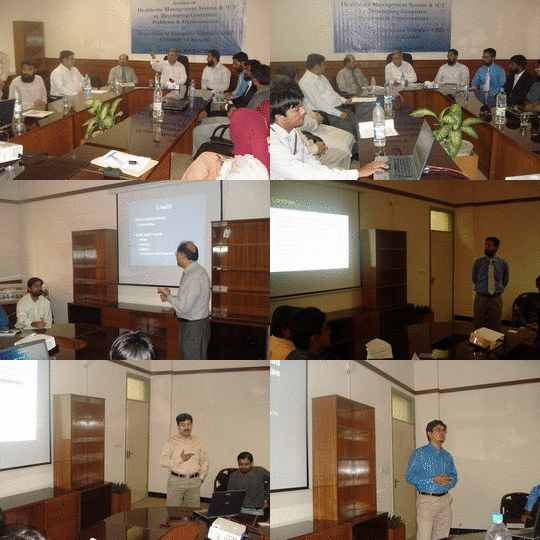 |
Message from the Vice Chancellor-UoK
I appreciate the efforts being made by the Dept. of Computer Science to develop e-health services at the varsity. Their objective is to utilize ICT in healthcare management in the context of our country to provide effective health services at low cost through exploiting of information and communication technologies. The university will extend all the support to the group.
PATRON
Prof. Dr. Muhammad Qaiser (VC-UoK)
CORE GROUP
- Prof. Dr. S. M. Aqil Burney (Group Leader)
- Dr. Kamran Ahsan (Intl. Coordinator)
- Dr. Nadeem Mahmood (DCS-UoK)
- Mr. Zain Abbas (DCS-UoK)
- Dr. Zahid Bashir (Aga Khan University/SMDC)
MEMBERS
- Mr. Asim Ali (DCS-UoK)
- Dr. Shoaib Rizvi (SIUT)
- Dr. Abid Azhar (KIBGE-UoK)
- Dr. Haider Abbas (Psychology-UoK)
- Dr. Shakeel Farooqui (Genetics-UoK)
- Dr. Ali Farhan (LCMD / DarulSehat Hospital)
COLLABORATION WITH STAFFORDSHIRE UNIVERSITY, U.K.
|
|
| Prof. Dr. Aqil Burney at the University of Staffordshire (UK) to represent the UoK HMS-ICT group (Feb 2010) |
INTERNATIONAL CONFERENCE
The group presented a paper at the First International e-Health conference in Pakistan at AKU during Jan-2010. Main objective of this conference was to introduce and advocate e-Health as a viable and relevant option for improving public and private healthcare in Pakistan.
SEMINAR
A seminar on "HMS & ICT in Developing Countries" was held at DCS (UBIT), University of Karachi in coordination with Staffordshire University Health Sciences Department in Jun-2009. Staffordshire University was represented by Mr. Kamran Ahsan.
The speakers emphasized on the importance of ICT especially in service sector due to the increasing cost of medical care and lack of penetration of health facilities in the remote areas of Pakistan. It was concluded the mammoth growth of communication and technology, if utilized in health sector, has the potential for delivering far reaching and cost effective health care to all citizens of the country.
PROJECTS
The group members have undertaken several projects. One project is based was an e-Health application for creating awareness about epidemics such as Swine flu and dengue fever. Moreover, we are specially focusing on airborne, waterborne as well as skin diseases. Another project is a dietary management application for hospitals and other health related issues.
Seminars & Events
- Inauguration of Industry University Coordination Programme in ICT
- Lecture on "Optical Recording of Neuronal Networks"
- Hong Kong universities delegation
- Seminar on Health Management System & ICT
- Inauguration of Seminar & Digital Library
- Seminar on Cyber Crimes
- Intel Workshop
- Governor Sindh visits UBIT
Contact
For further information please contact:
DEPARTMENT OF COMPUTER SCIENCE - UBIT
UNIVERSITY OF KARACHI, KARACHI-75270
Telephone: 99261300-06 Ext: 2462
Website: www.uok.edu.pk/dcs-ubit
Email: dcs@uok.edu.pk / info@uok.edu.pk
Apply to the Department of Computer Science
MCS, BS, MS, PhD and evening PGD pathways are open through the University's admissions process.

