



Center for Digital Forensic Science & Technology
Introduction
Director: Dr. Nadeem Mahmood.
For the first time in Pakistan University of Karachi is offering the Digital Forensic education at the undergraduate / graduate / post graduate/ MS & Ph.D. level. Centre for Digital Forensic Science & Technology will keep functioning for the betterment law enforcement agencies, specially judiciary for its quick justice for public interest and economic viability for public at large.
CDFST will play an integral role in the criminal justice system. This Centre will support law enforcement agencies (Police, Rangers, NAB, FIA, CPLC and etc.) in meeting the expectations of Government and community. The Centre will strive connecting the crime scene and judicial system through the development and delivery of impartial expert scientific opinion evidence. This Centre will educate resolving complex criminal cases and will be a bridge in providing easy access to criminal justice system with its advanced curriculum. This Advanced Digital Evidence Educational System will be a value added to the conventional evidence system of Pakistan. This Centre will impart digital forensic education to the new generation of students who have the aptitude and desirous of joining this exciting and newly emerging subject in Pakistan.
This Centre is committed to provide qualitative digital forensic education with state of the art facilities and will play its crucial role in economic strengthening of Pakistan. This Centre will create new job opportunities and provide a clear career path towards specialization to the students undertaking such programs. Inter-alia qualified manpower will be available to the public and private sector in various fields as applications of digital forensic science are not limited to criminal law, and can include civil law, product liability, medical integrity, highway safety, environmental protection, consumer protection and national security.
Presently, many universities are providing courses/programs ranging from BSc. (Hons), Masters, M.Phil and Ph.D in various subjects like Bio-chemistry, Bio-informatics, Physics and chemistry etc related to forensic science in one context or another. Availability of digital forensic studies program at a suitable level can provide a clear platform for dedicated digital forensic science studies for a career start. Similarly, the police forces and law enforcement agencies will have a growing demand in future for inducting digital forensic analysts/experts to make their investigations more effective, objective and scientific in nature rather than to rely on the existing obsolete methodology and technology.
This Centre will range all laws e.g. Prevention of Electronic Crime Evidence Ordinance 2007, Investigation for Fair Trial Act, 2012, Law in process on Cyber Crime and will adopt any future legislation as well.
Chancellor's Speech
Chancellor's Speech
Assalam-o-Alaikum Ladies & GentlemenI from the bottom of my heart really appreciate all distinguished guests for your valuable presence in this historic inauguration ceremony of Centre for Digital Forensic Science & Technology University of Karachi.
I must congratulate Prof. Dr. Qaisar, Vice Chancellor, Karachi University and his team on stepping towards the world of achievements especially in the field of Digital Forensic Science & Technology despite of all the difficulties. I foresee that the substantiating advancement will rejuvenate the supremacy of this nation on the globe. However, this Centre will definitely be playing its role as one of paving components of Rule of Law. As we all know that “The rule of law requires balance between rights and responsibilities, where no one is above the law — including the government. The Constitution guarantees fundamental rights and everyone is supposed to have access to justice, including the accused and I hope this blended education will serve the purpose in letter and spirit. This omnipotent Centre for Digital Forensic Science & Technology will go long way to success of this university.
I am very pleased, honoured & satisfied indeed to be with you as an ICON of this tremendous inaugural ceremony of this Centre for Digital Forensic Science & Technology, University of Karachi
University of Karachi has been contributing to society through the pursuit of education, learning, and research since June 1951. I hope this Centre for Digital Forensic Science & Technology will foster and produce students of the highest intellectual potential, irrespective of social, racial, religious and financial considerations, and then support them through their intellectual journey.
The dedicated, highly qualified professional faculty members, and digital forensic experts will play their due role for this paradigm shift and will bring about turn-around in all aspects.
I hope this Centre will provide unique, creative, progressive and inspiring environment to our researchers, faculty members, students and staff. Despite tumultuous circumstances University of Karachi keeps combating the challenges and always in preparation for upcoming challenges.
On this occasion I must say that all august members of Senate, Syndicate, Academic Council, Finance and Planning Committee always play their vital role in devising / formulation long term strategies in line with missions and core values set forth to path on dream come true of University of Karachi
I pay tribute to the hard work, creativity and determination of colleagues across the University and I want to close by thanking them for all that they will do to promote and deliver the highest standards of education and research excellence at this Centre for Digital Forensic Science & Technology.
Vice Chancellor's Speech
Vice Chancellor's Speech
I feel pride to address on this historic and commemorating inauguration ceremony of first ever Centre for Centre for Digital Forensic Science & Technology and feel pleasure to extend my warm welcome to Honorable Governor Sindh Dr. Ishrat-ul-Ibad Khan, Major General Bilal Akbar, and Director General Rangers, all distinguished guests, faculty / staff members and friends from media. In view of this fact "Digital Forensic Science Education and training is of prime importance for the development of a nation. No country can progress unless it goes with the pace of Globe. In this regard I am very pleased that this first-ever Centre for Digital Forensic Science & Technology of Karachi University will commence embarking its milestones under charismatic and visionary leadership of Honorable Governor Sindh Dr. Ishrat-ul-Ibad Khan. I formally hereby proceed with due permission from Honorable Governor Sindh for introduction, vision, mission and objectives of CDFST
Seminar/Workshops
Vision
To disseminate the knowledge of Digital Forensic Science to the society for serenity in life through different levels of courses / degree programs including Certificate to Post Graduate Diploma.
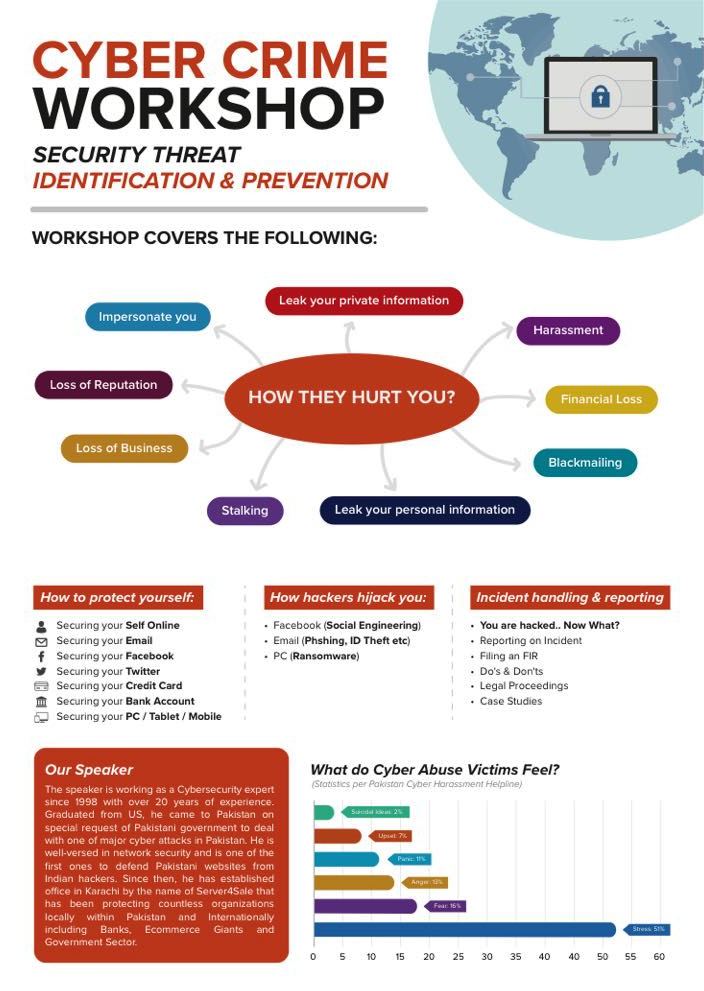
Understanding the Real Cyber Crime
Security, Threats, Identification and Prevention
- Why to secure your information ?
- This workshop resolves all your confusions !
- Don’t miss this important workshop !
- What you can do to protect yourself ?
- Who is responsible for your organizations data ?
- Should we really be worried about cyber attacks ?
- I am not IT Person ! How do i secure my data ?
- Does it really matter for me ?
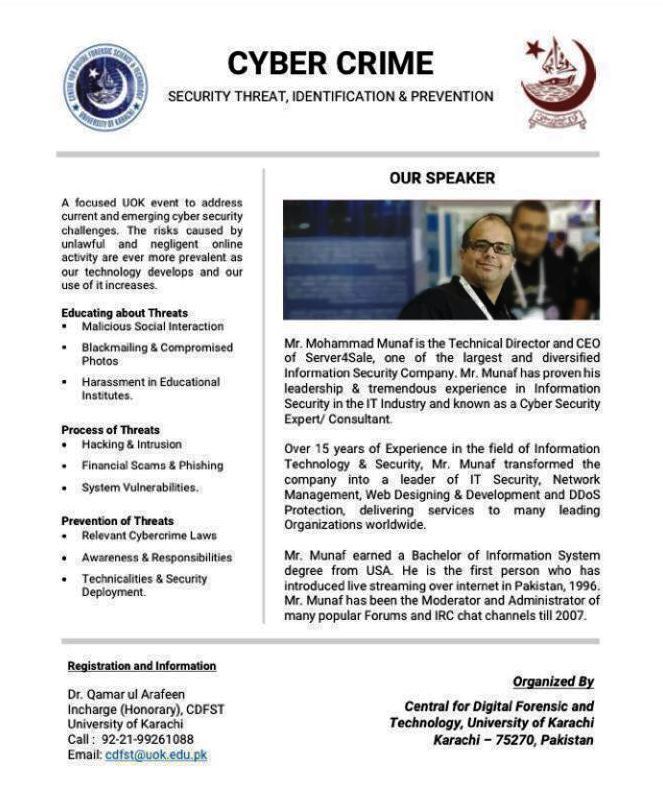
Seminar/Workshops on Cyber Crime
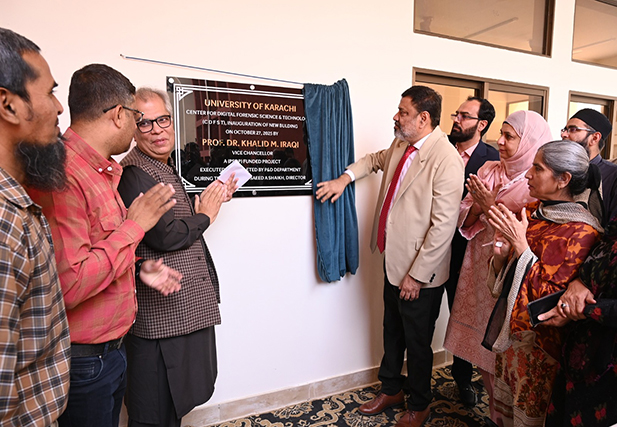
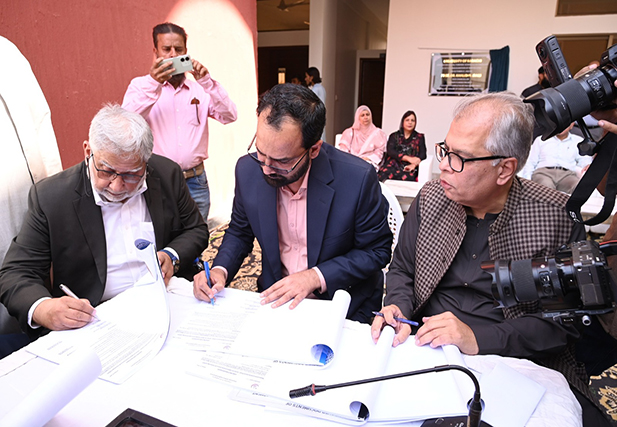
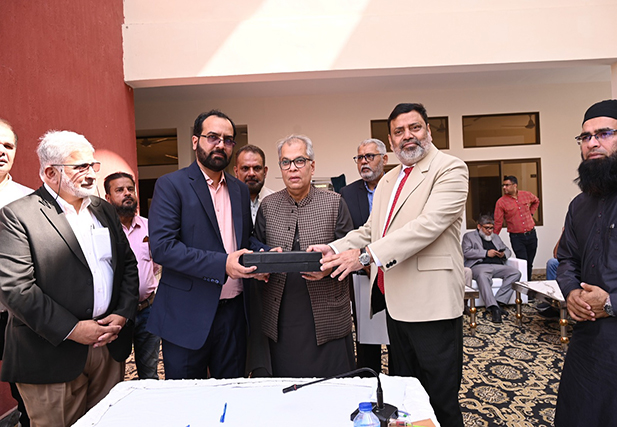
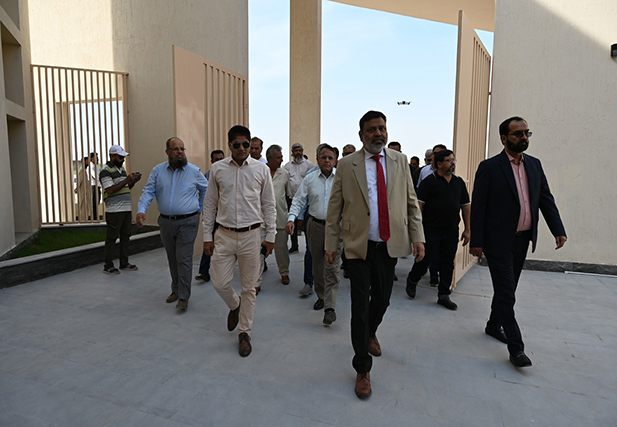
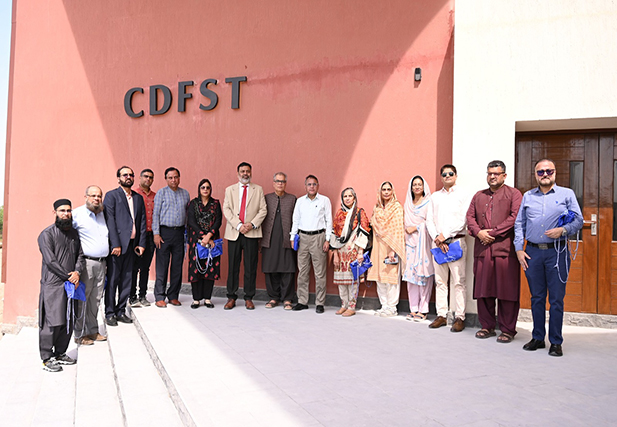
Governor inaugurates first-ever Centre for Digital Forensic Science and Technology
View more pictureMission
Mission
To contribute knowledge through the pursuit of Digital Forensic Education, Learning, and Research at the highest international levels of excellence.
Objective
Objective:
- Establishing Digital Forensics as formal course of studies.
- To strengthen LEAs and Judiciary through Digital Forensic Evidence.
- Acquainting students with international standards in Digital Forensic methodologies.
- Meeting futuristic demands of forensic expertise .
- Expanding the horizon of DFS using Information Communication Technology (ICT) based knowledge.
- Innovations through Research & Development.
- Enhancing HR for Demanding Opportunities.
Programs
Degree / Certificate Programs
- The webpage is temporarily unavailable to visitors as the construction process is underway
Courses
Forensic Science Program is a proposal if considered, reviewed and approved will be launched under the umbrella of Karachi University. CDFST will provide forensic education and will make its program pragmatic in conjunction with Forensic Science Laboratory. This FSP will standardize in precise criminal detection and also to enhance the capacity of law enforcement agencies through modern scientific tools, training and equipping them with latest criminal investigation techniques. This will help in achieving public trust in the criminal Justice System of the country.
Forensic science program will play an integral role in imparting and disseminating forensic education in this region. FSP will enable students how to connect crime scene and judicial system through the development and delivery of impartial expert scientific opinion evidence.
CDFST will vigorously step ahead to establish the latest and well equipped laboratories and other related infrastructure in Karachi University and assuring to be the best facilitator of criminal justice system.
Unfortunately the province of Sindh is severely devastated by criminal actions like extortion, kidnappings for ransom, activities of terrorism, corporate crimes and fraudulent activities. In the current changing global scenario and emerging issues of crime, terror control and security in Pakistan in general and in Sindh in particular, the need for a lead agency and efficient forensic service provider is greater as never before. In this prospect, CDFST will aim at serving the country to its best ability by providing the best quality education in this regard.
We will definitively create a difference in this regard and highly appreciate the support and assistance from government offices, international donors and partners in efforts to make this project a success.
Computer Forensic
Computer forensics is a branch of digital forensic science pertaining to legal evidence found in computers and digital storage media. The goal of computer forensics is to examine digital media in a forensically sound manner with the aim of identifying, preserving, recovering, analyzing and presenting facts and opinions about the information.
Computer forensics will be an important and integral part of CDFST pertaining to legal evidence found in computer systems and digital storage medium. It is to perform forensic investigation on digital evidence while maintaining the documented chain of custody so that it can be presented as evidence in the court of law.
Scope of Computer Forensics
- Scientific examination and analysis of Digital Storage Media for example hard drives, Flash Memory, Floppy Disks, CD/DVD etc.
- Forensic Analysis of Mobile phones and Personal Digital Assistants (PDAs).
- Forensic Examination of standalone/ networked computers after a break-in, for example, to determine how the attacker gained access and what the attacker did.
- Retrieve/acquire evidence from digital media.
- Recovery of deleted digital data in case of damaged hardware that may have evidentiary value.
- Recovery of deleted digital data in case of software failure that may have evidentiary value.
- Forensic Analysis of retrieved and/or submitted media.
- To provide expert testimony on resultant analysis on Agency cases in the Court.
MOBILE FORENSICS
Mobile device forensics is a branch of digital forensics relating to recovery of digital evidence or data from a mobile device under forensically sound conditions. The phrase mobile device usually refers to mobile phones; however, it can also relate to any digital device that has both internal memory and communication ability, including PDA devices, GPS devices and tablet computers.
NETWORK FORENSICS
Network forensics is a sub-branch of digital forensics relating to the monitoring and analysis of computer network traffic for the purposes of information gathering, legal evidence, or intrusion detection. Unlike other areas of digital forensics, network investigations deal with volatile and dynamic information. Network traffic is transmitted and then lost, so network forensics is often a pro-active investigation.
DATABASE FORENSICS
Database forensics is a branch of digital forensic science relating to the forensic study of databases and their related metadata. The discipline is similar to computer forensics, following the normal forensic process and applying investigative techniques to database contents and metadata. Today almost all applications use high performance databases to deal with data. So the database security community is coming up with a number of different techniques and approaches to assure data confidentiality, integrity, and availability. But it is observed that digital attacks are targeting the databases ensuing database security breaches and threats. The outcome is that the existing laws / regulations are specifying investigations and response to security breaches or policy violations. This gives rise to the need for database forensics which satisfies this demand. Organizations must, therefore, consider their incidence response policies carefully, which are part of their overall security policies.
CYBER CRIME
Cybercrime is a bigger risk now than ever before due to the sheer number of connected people and devices. You often hear the term 'cybercrime' bandied about these days, as it's a bigger risk now than ever before due to the sheer number of connected people and devices. But what is it exactly? In a nutshell, it is simply a crime that has some kind of computer or cyber aspect to it. To go into more detail is not as straightforward, as it takes shape in a variety of different formats. We've put together this guide with some interesting and often alarming facts, to make it a little easier to digest:
Cybercrime: The facts
- Cybercrime has now surpassed illegal drug trafficking as a criminal moneymaker
- Somebody’s identity is stolen every 3 seconds as a result of cybercrime
- Without a sophisticated security package, your unprotected PC can become infected within four minutes of connecting to the Internet.
Criminals committing cybercrime use a number of methods, depending on their skill-set and their goal. Here are some of the different ways cybercrime can take shape:
- Theft of personal data
- Copyright infringement
- Fraud
- Child pornography
- Cyberstalking
- Bullying
As you can see, cybercrime covers a wide range of different attacks, that all deserve their own unique approach when it comes to improving our computer's safety and protecting ourselves. Symantec draws from all the different interpretations of cybercrime and defines it concisely as "any crime that is committed using a computer network or hardware device"
The computer or device may be the agent of the crime, the facilitator of the crime, or the target of the crime. The crime may take place on the computer alone or in addition to other locations. The broad range of cybercrime can be better understood by dividing it into two overall categories, defined for the purpose of this research as Type I and Type II cybercrime. Let’s take a look at them both:
Audio / Visual Analysis
Audio / Visual Analysis Unit will deal with the scientific examination, comparison and/or evaluation of audio and video evidence in legal matters. The Audio Visual Analysis Department will be equipped with latest forensic tools for audio and video analysis which are used all over the world in Forensic Community. This will also cover the following:
- Clarification of Audio evidence using different noise reduction and other algorithms.
- Clarification of Video evidence for identification and association of different events happened by video surveillance systems.
Analysis of images extracted from video evidence using forensic enhancement and clarification tools.
Video forensics is the scientific examination, comparison and/or evaluation of video in legalmatters. Video forensics reliably digitizes video tape footage onto a computer system, be able to de-multiplex or separate camera views from multiplexed CCTV footage, convert digital video from DVR (Digital Video Recorder) devices into digital video formats usable for forensic analysis. Video forensics also performs clarification techniques such as frame averaging, highlight someone or something of interest in the video, enlarge portions of the video for areas of interest, measure heights of individuals or distances between points seen in the video.
GPS FORENSICS
Modern Global Positioning Systems (GPS) devices are capable of storing vast amounts of navigational data in the form of maps, track lines, waypoints, routes, and more. Some of this data is captured and stored automatically by the device whenever it is in use. Other data is manually entered by the GPS user. In the hands of a law enforcement investigator, the data can be used as devastating evidence in a courtroom setting. GPS Forensics provide law enforcement officers with a foundation for recovering evidence from GPS devices and preparing it for courtroom presentation.
GEO FENCING
A Geo-Fence is a virtual perimeter for a real-world geographic area. A Geo-Fence could be dynamically generated—as in a radius around a store or point location, or a Geo-Fence can be a predefined set of boundaries, like school attendance zones or neighborhood boundaries.
The use of a geo-fence is called geo-fencing, and one example of usage involves a location-aware device of a location-based service (LBS) user entering or exiting a geo-fence. This activity could trigger an alert to the device's user as well as messaging to the geo-fence operator. This info, which could contain the location of the device, could be sent to a mobile telephone or an email account.
CRIME SCENE INVESTIGATION UNIT
The process of using physical evidence at crime scene and the use of reasoning to gain knowledge of events surrounding the crime is referred to as Crime Scene Investigation. Crime scene investigation is multidisciplinary field and involves a systematic search of the crime scene as well as the identification, processing and collection of physical evidence.
Processing the crime scene
- Photography
- Sketching
- Documentation
- Audio Recording
- Video Recording
Collection of evidence
- Physical evidence
- Biological Evidence
- Trace Evidence
- Impression Evidence
- Packaging and sealing of evidence
- Maintaining Chain of Custody forms
Death Scene Investigation
- Aiding in the determination of the Cause, Manner and Mechanism of Death
- Photographing and Documenting the body
- Aiding in the Estimation of the time of death
Reconstructing the scene
- Blood Spatter Analysis
- Projectile Trajectory Determination
- Creating a replica of the crime scene in Lab to test hypotheses
- Determining the number of people involved
- Determining the sequence of events
Research
Research & Service Centre will render its research services in latest technologies, email, whatsapp, viber, imo, Analysis of IP Traffic, Tango etc. This will also produce research based analysis for Judiciary and Law Enforcement Agencies. Finally the establishment of such center of dire needs shall improve precise criminal detection facilities for Law Enforcement Agencies (LEAs) in the jurisdiction as determined by competent authority and also enhance LEAs capacity through modern scientific tools, training and equipping them with latest criminal investigation techniques. This will also help in achieving public trust in the criminal Justice System of the country.
Accomplishment of this center as stated above requires Financial & Human Resource support (highly qualified and experienced professional human resources) from Government. Judiciary also adjudicated in Constitutional Petitions of Appellate Jurisdiction, Supreme Court, Constitutional Petitions of High Court and Constitutional Petitions of Original Jurisdiction, Supreme Court.
Gallery
Workshop
Understanding the Real Cyber Crime
Security, Threats, Identification and Prevention
- Why to secure your information ?
- This workshop resolves all your confusions !
- Don’t miss this important workshop !
- What you can do to protect yourself ?
- Who is responsible for your organizations data ?
- Should we really be worried about cyber attacks ?
- I am not IT Person ! How do i secure my data ?
- Does it really matter for me ?
Date : 01 February 2018
Time : 09:30
Arts Auditorium, University of Karachi
Hurry up! Registration
Email your name, Department name, Job title and mobile numberhttps://vyeimcbg.paperform.co